Fungi
Fascinating Fungi
Fungi are an essential but often overlooked part of the New Forest’s natural world. Beneath the soil and among fallen leaves, logs and tree roots, fungi quietly support the health of the Forest by breaking down organic matter, recycling nutrients and forming vital partnerships with plants and trees. Without them, the Forest as we know it simply couldn’t function.
The New Forest is one of the richest places for fungi in the UK, with its ancient woodlands, varied habitats and long history of low-intensity land management creating ideal conditions for an extraordinary diversity of species. From colourful toadstools and delicate bracket fungi to vast underground networks of mycelium, these organisms play a crucial role in sustaining biodiversity – and remind us why protecting the Forest’s soils and habitats is just as important as caring for what we see above ground.
Bearded tooth
The New Forest is a stronghold for Bearded Tooth (Hericium erinaceus), a very special and rare fungus as it is a legally protected species.
It is one of three species of this spectacular looking genus and all of them can be found in the New Forest. Hericiums are confined to only a few other sites in the south of England.
Beech trees, both living and dead, are its favoured host and these are widespread in the New Forest. The tree can be standing upright with the Hericium on the trunk, or sometimes quite high up in the branches or on a fallen decaying trunk. If the fallen trunk happens to be hollow, the fruiting might even appear inside the hollow.
Although it may look fragile, it is surprisingly robust, but may slowly lose its pristine white colour and become rather brown and dirty looking. However the entire fungus will remain intact for several weeks during the autumn, or until the night frosts begin.
It comprises a large rounded clump of compact, long, hanging, pointed tipped spines, soft and elastic in texture and all initially bright white. It is usually solitary, although they may form a small group, and will often appear in exactly the same position every year.
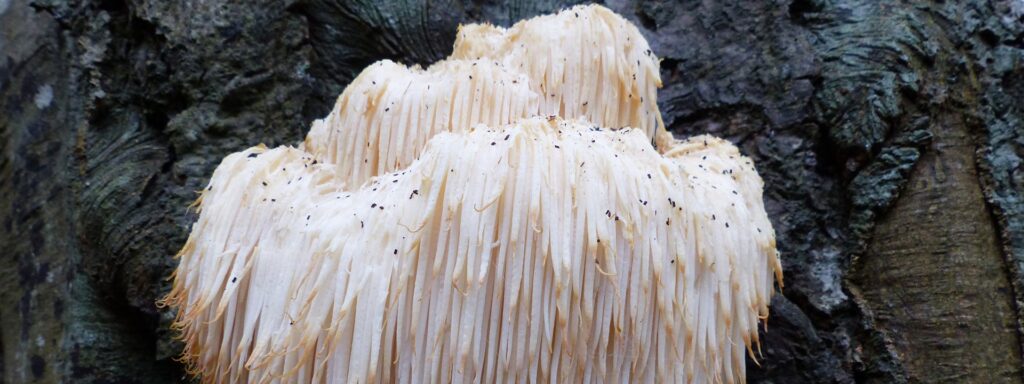
Over the years it seems to have acquired a number of different names – such as Monkey Head, Pom Pom, or Lion’s Mane to name but a few!
The New Forest is a very important site for this fungus in Britain, and it is the subject of many ongoing scientific surveys and research.
Brown birch bolete
Brown Birch Bolete (Leccinum scabrum) is a widespread and common species in the New Forest because it favours the extensive areas of woods and heaths colonised by birch trees, with which it has a special relationship and so is strictly associated with them.
Even in areas where birch trees have been felled, and where there are none, or only a few trees remaining, it may still be possible to see the Brown Birch Bolete fruiting singly or in a group, anytime during the summer, through to the autumn.
With the comparatively recent revival of the use of natural dyes, Brown Birch Bolete can produce a green dye, if it is used with a suitable chemical mordant.
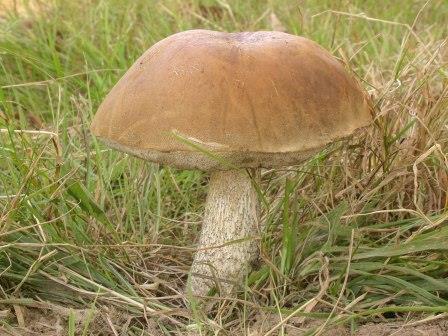
It is hemispherical becoming convex or flatter as it matures. Underneath the cap there are small round pores (that look like a sponge) that are greyish brown, or even a dirty white, in colour and that may bruise an ochraceous yellow when handled. The thick whitish stem, with no ring, is up to 20 cm long and is covered with coarse and woolly dark brown/black scales which is a distinctive field characteristic feature of its genus. Also, the overall size of the cap always looks rather small in proportion to the long stem.
Chicken of the woods
The New Forest is home to nationally important oak woods which include large numbers of amazing mature oak trees, many of which are in various stages of decay. This is the type of habitat that is excellent for Chicken of the Woods (Laetiporus sulphureus) to thrive. Growing out from the trunk or branches of standing, and still living trees, as a shelf or bracket fungus, it is often such a bright yellow colour that it can be spotted at quite a distance away.
It is robust and long lasting, although it becomes crumbly in texture and loses its bright colour with age to become plain and straw like. The whole structure can be a considerable size, sometimes a metre or so vertically and even horizontally. It can be an impressive sight.
It is not uncommon to see it in any deciduous wood in the New Forest, although oak is the favoured host. The fruiting body emerges as a large yellow lump before the ‘shelves’ form and is at its splendid best from early summer through to the winter, when it very slowly disintegrates and eventually falls to the ground in crumbling chalky pieces.
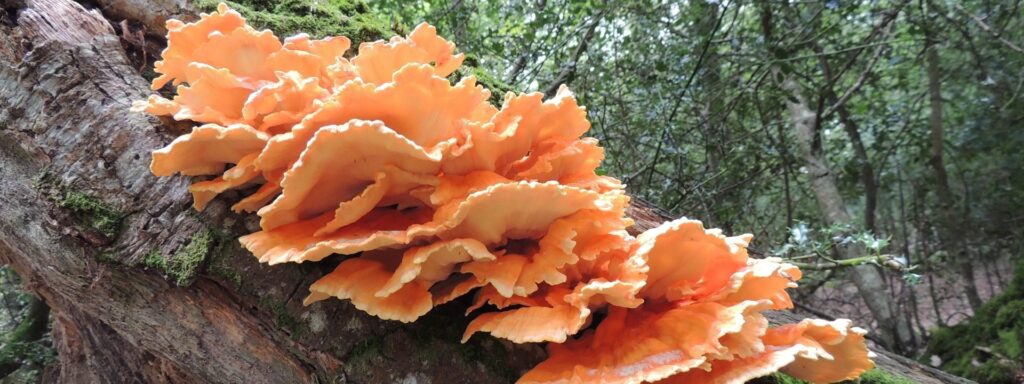
Chicken of the woods consists of overlapping, tough, leathery, fan shaped brackets it can have bright orange colour zones on the upper yellow, suede-like surface. The underneath of the fruiting body reveals vivid sulphur-yellow pores (instead of gills) which enable the fungal spores to drop and disperse.
Crimson waxcap
The Crimson Waxcap (Hygrocybe punicea) can be found in pasture growing in small groups or rings.
Waxcaps include some of our most colourful species. To some people, they have even earned the title of ‘orchids of the fungal kingdom’. The New Forest has large areas of unimproved grassland that has not been spread with any artificial fertiliser, and the sward is also closely grazed by the ponies and cattle, thus providing the ideal habit for these pretty waxcaps.
They are small mushrooms (6 or 7cms high) growing in groups or solitary, with often several different species growing on the same patch of grassland. They come in a variety of colours – all shades of red, pink, orange, yellow, black, white, purple, shades of brown and even shades of green. However they are all different species of the same genus. The cap may be dry, greasy or viscid and some of them have a definite smell such as honey, leather, garlic or even burnt rubber, which all aids in identification.
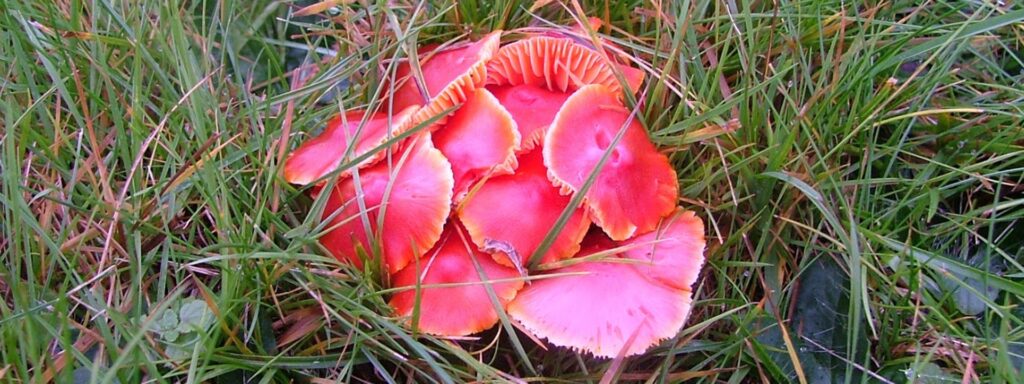
All the fruiting bodies can be seen on the grasslands in the New Forest from late summer through to the autumn, and certainly before any night frosts bring an end to their appearance.
The brilliant red colour though, as with all Waxcaps, begins to fade to a red/ orange after a few days.
The Scarlet Waxcap is probably the largest of the species and is fleshy with a greasy cap, the margin of which can be yellowish, and with a thick fibrillose (covered with tiny hairs) stem.
Deathcap
Deathcap (Amanita phalloides) is one of the most poisonous mushrooms in the British Isles and it can certainly be found growing in the New Forest.
In fact, in the south of England it may be frequent and widespread. It is probably the most notorious and aptly named of all mushrooms.
The New Forest has large areas of woodland with oak and beech trees, with which the mushroom has a special relationship. The Deathcap is not uncommon – especially so, on the less acid and more alkaline sites, such as in the south of the New Forest. It may be seen growing singly or in small groups, but it can even occasionally form fairy rings too. The fruiting bodies will appear from mid-summer to the end of autumn.
The cap is totally smooth and convex when young, then expanding to 10-12 cm across. The gills are crowded and white. The cylindrical stem is up to 15 cm long and is mainly white as well, but may be flushed with the olive green colour of the cap. The white fragile pendulous ring quickly falls away to leave the stem bare. The base of the stem is always surrounded by a persistent white volva (or egg cup like bag), in common with all fungi of this genus. The fruit body has a sweet fruity odour possibly akin to rose petals. However as the mushroom matures the smell becomes stronger and becomes unpleasant to some.
There is also an all-white form of Deathcap (Amanita phalloides var.alba) which although less common, can unfortunately, seriously confuse identification.
The Deathcap is responsible for more deaths from fungal poisoning that any other mushroom. It contains a number of toxins which are not reduced by freezing or cooking. Only a small section of the cap is needed for a fatal dose. Apparently, a few hours after ingestion of the mushroom it can cause nausea, vomiting and diarrhoea, then after a few days a feeling of recovery and wellbeing. However, after a week to 10 days, there is death from kidney and liver failure.
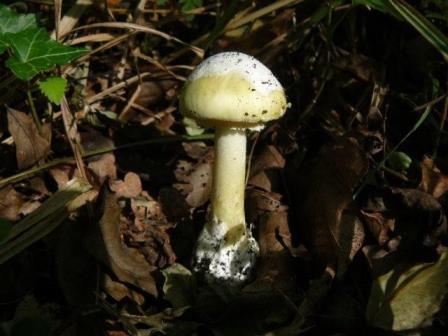
The dreaded Deathcap has a smooth shiny olive green cap which may be covered for only a short period of time by white scurfy and rapidly disintegrating fragments, which are remnants of the white veil which originally covered the entire growing mushroom.
Devil's Fingers
Devil’s Fingers (Clathrus archeri) is a rare fungus that was first found in the New Forest in around the year 2000.
At that time, the only other place that it could be found in Great Britain was one small place in Cornwall, so many mycologists came to the New Forest to see it. So it was an important New Forest speciality with a definite stronghold in the area. Remarkably since then, it has spread all over the New Forest – to be found in the woodlands and out in the open grassy areas, even appearing several years after gorse and heather has been burnt.
The ‘egg’ part of the fungi has the size and shape of a golf ball lying on the ground, but is attached to an underground network of threads (or mycelium) by a long thick strand. It is gelatinous in texture, with a pink tinge from the tentacles or arms submerged inside, and surprising can remain in that state for several weeks, whilst waiting for conditions to be favourable enough to grow. The red tentacles eventually emerge, initially joined at the tip before arching backwards into a star shape. There are always at least three or four tentacles, sometimes even seven or eight, with the upper surface pitted with reticulations, and covered with an evil smelling, olive-coloured, slime (or gleba) which contains the spores.
The entire structure is about 5cm high with tentacles of about 7cm long. Flies, beetles and slugs are attracted to the smell of rotting flesh, and the slime sticks to them when they come into contact with it, and so the spores are dispersed far and wide. It has obviously proved to be an excellent way of spore dispersal, to have allowed colonisation of the entire New Forest in under 20 years, and now even some other places in the South of England. This is a unique and unusual way of spore dispersal for a fungus.
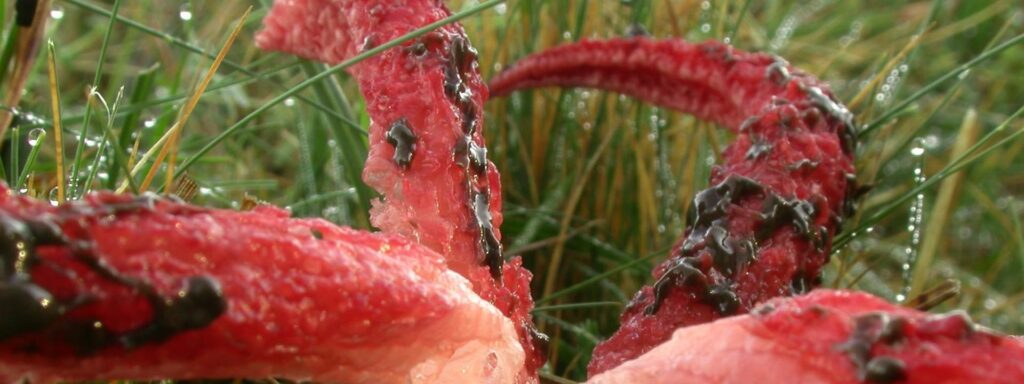
Devil’s Fingers is an alien species from the Southern Hemisphere, where in Australia it is called Octopus Stinkhorn. It is thought to have been introduced to Europe with various war supplies, or possibly with wool, in about 1914. This may account for the fact that it is regularly seen in the New Forest, sometimes in considerable numbers, in areas that were used by the military in 1942.
Dyers mazegill
Dyers Mazegill (Phaeolus schweinitzii) is to be found only with conifers, so it is quite common in the New Forest due to the many enclosures of these trees.
The Douglas firs that grow alongside the Ornamental Drive near Rhinefield House, Brockenhurst is always a good place to see it.
It is a bracket or shelf fungus, but can sometimes grow vertically direct from a tree root, when it will form a circular shape of tiered fruiting bodies fused together. It is parasitic on conifers and will cause brown cubical rot.
The time of active growth, however, is in the autumn when the fruiting bodies have a bright yellow growing edge to the bracket or, if very immature and erupting from a root, they may be circular and soft, starting as a large, bright yellow lump. The large semi-circular, or fan shaped, brackets may be up to 3 cm across, the yellowish brown velvety or hairy top is concentrically grooved with depressed dark brown centre. The actively growing margin will be quite bright shades of yellow and brown and is comparatively soft. The underside has elongated, irregular, maze like pores that are yellow, but bruise brown and then whole underside becoming brown with age.
The name Dyers Mazegill is an old one, from when this fungus was used in dying yarn in shades of yellow, orange or brown, which depended on the age of the fruit body. Natural dyes were used until 1856 when coal-tar dyes were invented, followed by synthetic dyes in the early 2 th century. Dyers Mazegill could also be used as a mordant to bind the fibres in the dying process. The underside of the fungus in those times could have been mistakenly referred to as ‘gills’ instead of pores, because of their elongated appearance.
False deathcap
The False Deathcap (Amanita citrina) is a rather slender, delicate mushroom of a whitish ivory, or even light yellow, colour may frequently be found growing in mixed woodland, but the many areas in the New Forest with mature beech trees, are excellent habitats for them.
It usually grows singularly, but there are often many fruiting bodies, in various stages of development, to be seen in any one area.
The stem has a pendulous ring under the cap, which increases in thickness to ground level where it forms a bulbous base fringed by a rim of thin tissue and an obvious gutter.
When smelt closely, it has a strong aroma of earth or new potatoes. It is poisonous but not as dangerous as the Deathcap.
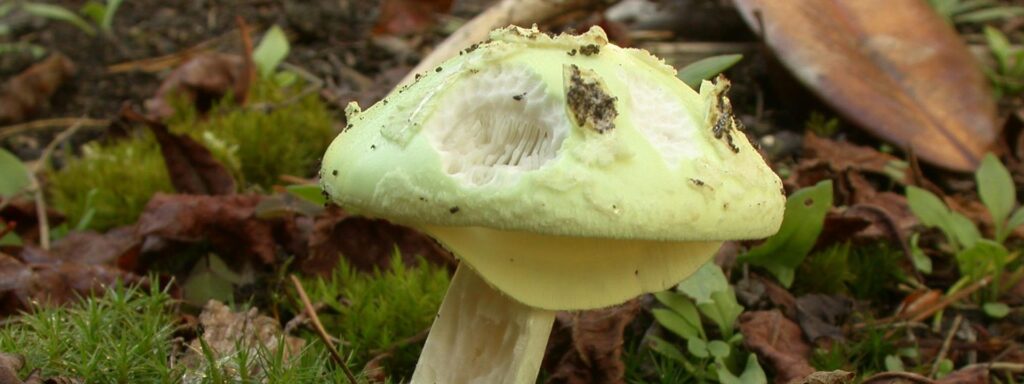
The false deathcap has a hemispherical cap covered with irregular yellowish scales, especially near the centre, some of which may be washed off by heavy rain leaving a smooth cap surface.
Fly agaric
Fly agaric (Amanita muscaria) is an easy species to see and identify in the New Forest.
The New Forest is an area of acid soils and dry heathland and this is where the ubiquitous birch trees are likely to be growing. This fungus has a symbiotic association with these particular trees, which is beneficial to both tree and fungus.
They may be solitary, or grow in small or sometimes very large groups.
The size of the actual mushroom may occasionally be as large as a dinner plate when mature and the cap fully expanded, but the average size for both cap width and stem height is about 20cms. The stem is white and thick with a bulbous base, called a volva, and a white pendulous ring with a scaly edge to it.
In medieval times the mushroom was crushed and mixed with milk, put on a saucer for troublesome flies to drink and stupefy themselves. This is the origin of its name – Fly Agaric – Agaric being a popular name for mushrooms and toadstools of this Order.
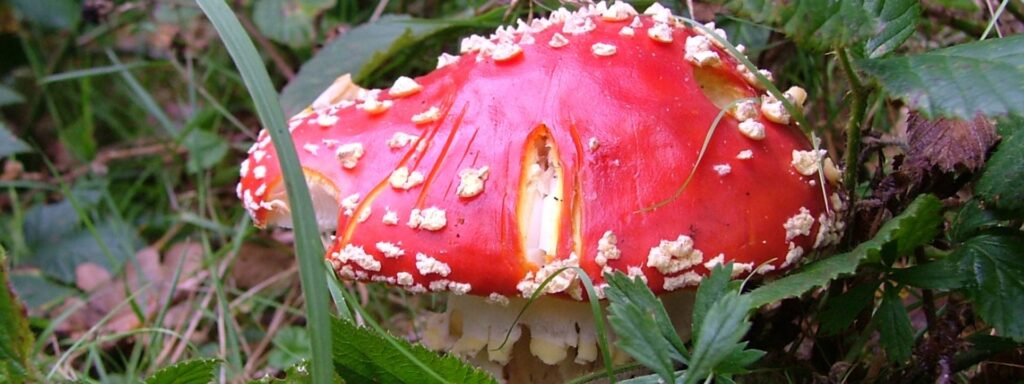
When fresh and unweathered, it is the classic children’s elves and goblins storybook toadstool. However in reality, the redness sometimes fades to a more orangey hue with age, and the white ‘speckles’ on the cap sometimes wash off partially, or even completely, in heavy rain, revealing a plain smooth red cap.
Golden spindles
Golden Spindles (Clavulinopsis fusiformis) are often called Grassland Fairy Club fungi because they are brightly coloured and easy to spot, whilst those of a similar genus are the opposite and are completely different microscopically.
They all have a preference for good clean grassland that has had no fertiliser or herbicide applied, in other words: totally unimproved grassland for a very long time. They will always disappear if the land is improved in any way. So the New Forest grasslands are an absolutely excellent habitat.
They are erect, unbranched, and wavy or twisted, with longitudinal grooves, and can be up to 12 cm high. The tips often turn a brown colour on maturity. Because they are conjoined at the base, they grow in dense tufts and large clusters on soil in amongst the grass and moss.
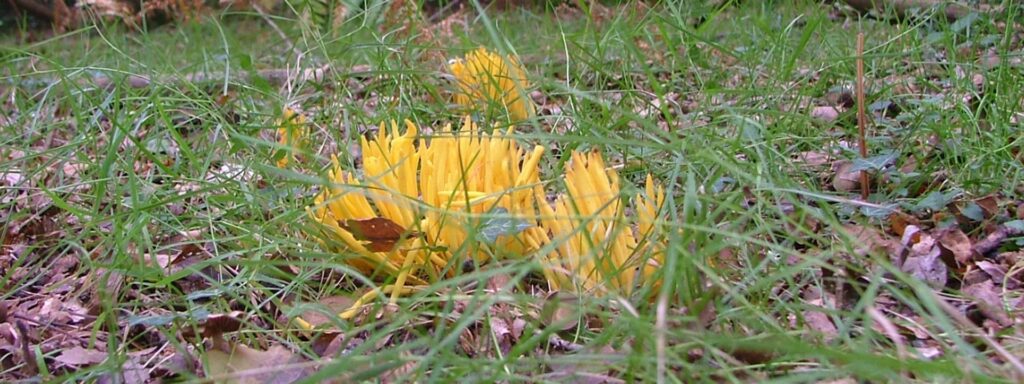
Golden Spindles are widespread and common, but there are many similar species, especially in the New Forest with grassland which includes pasture woodland, as well as large open areas. They can also be infected with a parasitic fungus which may alter the colour, so an exact identification may be difficult.
Appearing in the autumn they are bright yellow and spindle-shaped (or tapering at both ends), and the spores develop over the entire structure.
Honey fungus
Honey Fungus (Armillaria mellea) is parasitic fungus responsible for the death of many trees and shrubs in the New Forest and for which there is no effective means of control.
However, it is a perfectly natural occurrence in relatively unmanaged areas of woodland here. Dead and dying trees all contribute to the biodiversity and unique character of the Forest. Fungi can enable trees to thrive – but they have the potential to eventually destroy them.
There are several species of Honey Fungus – some more pathogenic than others. They cause intensive white rot. This particular species can be very variable and the cap size can be 3-15 cm across, convex then flattened tawny to dark brown with brown scales at its centre. The white spores produced by the gills can often be seen covering the surrounding area with what appears to be a white powder, especially in the summer to early winter. It will grow in dense clusters around trunks or stumps, and in the New Forest its presence is probably most often noticed on fallen beech and birch trees.
This fungus also has the name Boot-lace fungus. This is because it spreads by long black cords called rhizomorphs which closely resemble bootlaces. These bootlaces are very strong and durable and enable the fungus to spread from one tree to another. ‘Bootlaces’ can easily be found underneath the bark of infected trees at any time of the year.
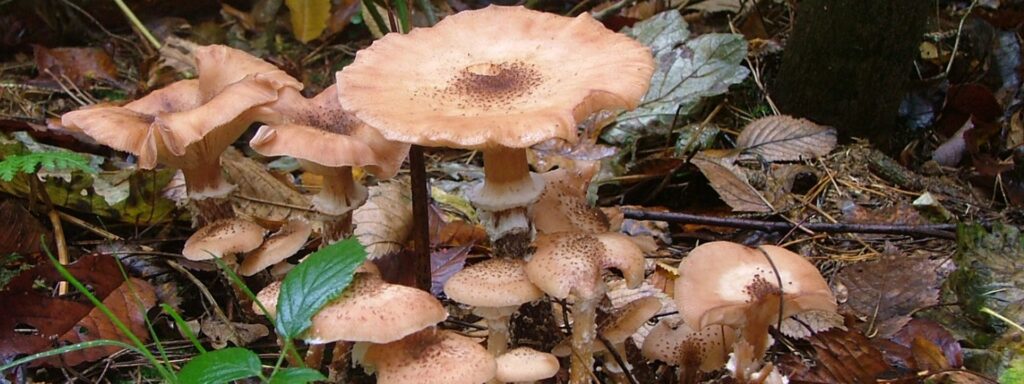
Honey Fungus can be the nightmare scourge of gardeners because it is so difficult to eradicate due to these rhizomorphs. They are even bioluminescent. When trenches were dug in the World War 11 revealing them, it was a concern that the position of the trenches might be made visible by glowing in the dark! Similarly in the London ‘blackout’, timber yards could glow at night, which might attract enemy bombers.
The stem is up to 15mm long and tapering towards the base. The gills are white initially, changing to yellow then brown and spotted darker brown with age.
Nail fungus
Nail Fungus (Poronia punctata) is a very rare fungus in the whole of Europe.
In Great Britain it is only to be found in the New Forest – so it is very special to the area and mycologists come from afar to see it. It is a small, but robust fungus, which only grows on the dung of equines that have lived on a high fibre, low nutrition diet. Because the ponies in the New Forest graze on the unimproved (or unfertilised) grassland and poor grazing under the trees, the resulting dung is very suitable for Nail Fungus to thrive.
Over 3,000 ponies, owned by New Forest Commoners, graze all the year round, and the fungus can be found in the autumn, when it is at its best, growing directly out of the piles of pony dung. It is possibly to see it well into the spring, if the piles of dung have not degraded or been scattered by the birds. The fruiting body is tough and long lasting, which is unlike many other fungi that live on dung.
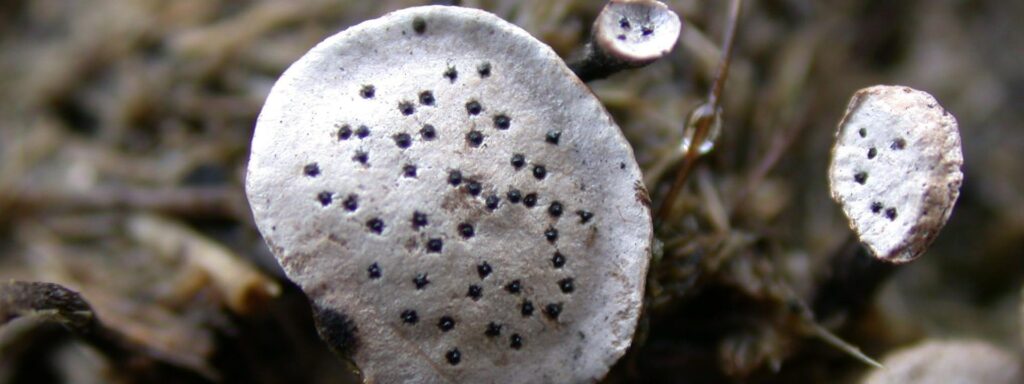
The black dots are the openings (or apothecia) from which the spores are produced to be dispersed by the wind. The stem is black and may be long and deeply rooted into the dung. Because it is able to survive for several months, it sometimes can be attacked by a secondary infection which will cause it to become velvety and soft, which will prevent spore dispersal. It is always found on the open grassland or heathland, and has not yet been recorded under woodland trees.
Since 1990, there are now a few areas in the south of England where New Forest ponies have been translocated to rough grazing on reserves to be used a conservation tool, where it may now be possible to see Nail Fungus. A similar fungus of the same genus, but which grows on rabbit droppings, has recently been found in the East of England, but so far has not been recorded in the New Forest.
The fruiting body is shaped like a nail and comprises a flat, dull white disc covered with black dots and only 1.5cm across.
Ochre brittlegill
As the name Ochre Brittlegill (Russula ochroleuca) implies, this mushroom has brittle gills, but also the entire fruiting body is quite fragile and has a crumbly consistency because it belongs to a genus which had a separate evolutionary line to other fungi.
They can easily be seen growing in any New Forest woodland which has a mixture of trees on acid soil. There is also a similar related species which is a much brighter yellow, growing in wetter boggy areas of woods, often with Spaghnum moss. Russulas are fruiting and at their best in late summer to late autumn, and are very common and widespread.
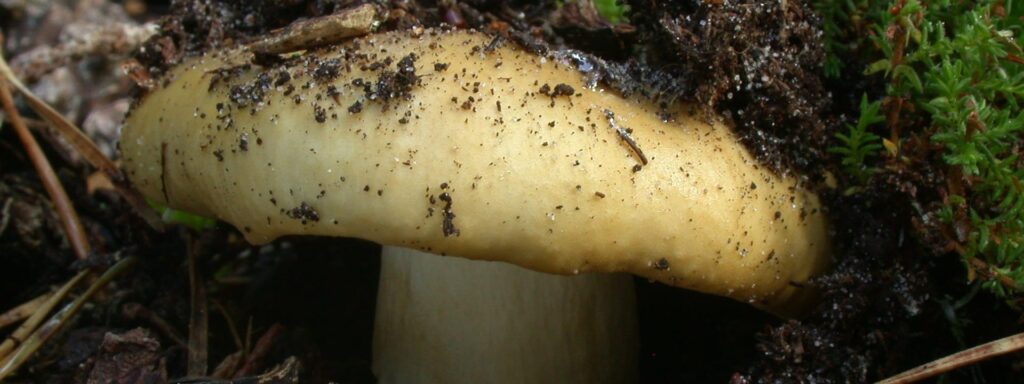
The gills underneath the cap are very brittle indeed and readily crumble like flaked almonds when handled. There is, however, one related species that has soft greasy gills and even smells of crab. The stem is about 7cm long, white or cream becoming greyish, and being brittle, will easily break like a stick of chalk, because it is composed of round cells.
An older name for the Ochre Brittlegill was Common Yellow Russula. The entire genus is often known as the ‘Roses of the Woods’ because of their large assortment of colours with varying shades of green, pink, red, orange, purple, brown and cream. They even have a variety of smells such as geranium, stewed apple, cheese, oil, crab, menthol and antiseptic. But colours and smells are not necessarily a great help with identification; Russulas are notoriously difficult.
The fruiting bodies are often eaten by slugs and snails, mice and invertebrates – and deer are fond on them too – one seldom sees a pristine unnibbled one. However, it seems that gut enzymes can stimulate the germination of spores – so all is not lost – the prime object of fruiting is being achieved.
The cap of the Ochre Brittlegill is up to 10 cm across, flat with a slightly depressed centre and is a yellow ochre colour but often with a greenish tinge.
Panthercap
At any time from summer through to the autumn, the Panthercap (Amanita pantherina) fungus may be seen in the oak or especially beech, woodlands of the New Forest, growing singularly or in small groups.
It is deadly poisonous, and should not be handled, but if observed carefully it is not too difficult to recognise.
It is of the same genus as the attractive red Fly Agaric (of fairies and goblins fame!) and has certain similarities to it. A large pendulous white ring is on a white stem of up to 10 cm long, and also a distinctive white girdle or two, just above the pronounced rim above the bulbous base. It is considered to have the background colour of a Panther – and be dangerous!
Pestle puffball
One of many puffballs of the extensive grassland areas of the New Forest, the Pestle Puffball (Lycoperdon exipuliforme) is probably the most often noticed, because it is tall, white, impressive, and is common and widespread.
The brown spores of Puffballs mature inside the ball and are then liberated in various ways, often when the entire fruiting body disintegrates so the powdery spore mass can dispersed by the wind. When mature, they can even be squeezed by hand which will make the dry brown spores fly out into the air. Quite fun and satisfying to do!
White or light buff coloured, usually maturing to various shades of brown, Puffballs may range in size from 6cm to 70cm across and up to 20cm tall, with or without a short stem. They grow singularly or in groups, or just spread out over a large area, and they may even form fairy rings. They are most easily seen in the late summer to early autumn and are widespread and common on grassy places.
Two small round species of Puffballs even detach themselves from the ground to blow around in the wind, and thus distribute their spores, which they are only able to do on the short well grazed grassland of the New Forest. At the other end of the scale, another species can grow to a huge size and may reach a record weight of over 10kg.
As late as the 19th century, unripe Puffballs were often used as a surgical dressing for wound staunching by surgeons and even as an anaesthetic, and bee keepers used them to calm bees. A bee keeper would put a smouldering pile of puffballs underneath the hive to enable them to gain access without being stung. No doubt it was probably the high level of carbon dioxide that calmed the insects! It is even recently suspected that Puffballs were involved in making and transporting fire and also being used as a form of insulation and draught excluder.
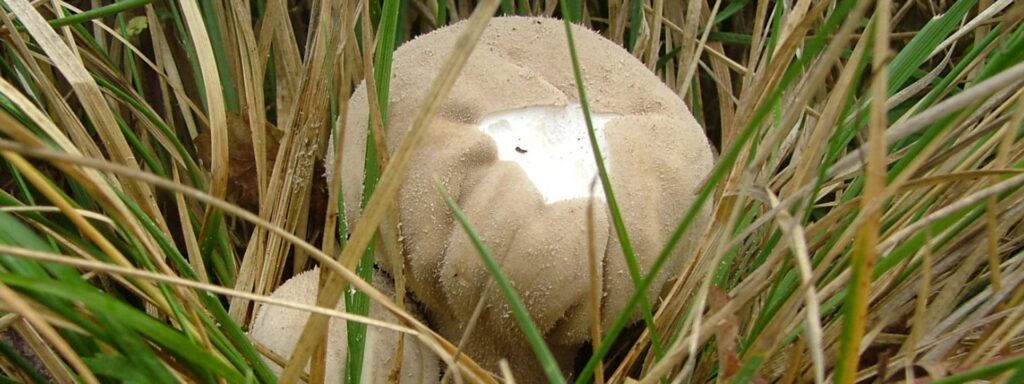
The Pestle Puffball has a stout 20cm long stalk, white in colour becoming a light brown as it matures. The fruit body is covered with fine spines or warts which it gradually loses revealing a smooth yellowish surface, when the apex of the pestle ball part splits exposing the spore mass.
Shaggy inkcap
Large, tall and upright with a cylindrical, white and fleecy cap which becomes black from the bottom upwards, the Shaggy Inkcap (Coprinus comatus) should be easy to identify.
They may grow singularly, but usually in small groups, and prefer to grow in grassland, but they are quite happy alongside footpaths, on waste ground or even bare or disturbed soil especially containing woody debris. So the New Forest is a good habitat for them and their often prolific fruit bodies are most likely to appear from April through to November.
The stem is hollow and about 15cm tall with a mobile or free ring, which few fungi possess, near the base. The shaggy cap is torpedo shaped which is widest at the base, and conceals a slender white stem when immature. The crowded gills underneath the cap are white at first, but quickly become black as the fruit body deliquesces (dissolves or auto digests) upwards from the bottom edge of the cap, as it breaks down into a black slimy fluid full of fungal spores. This liquefying aids the important dispersal of the spores.
In the 17th and 18th centuries this black liquid could be used as an ink substitute. It could be used straight as writing ink or in a more concentrated form by boiling down with phenol as a preservative. It was even suggested that it could be used for important legal documents and bank notes, as the absence of any fungal spores would indicate a forgery.
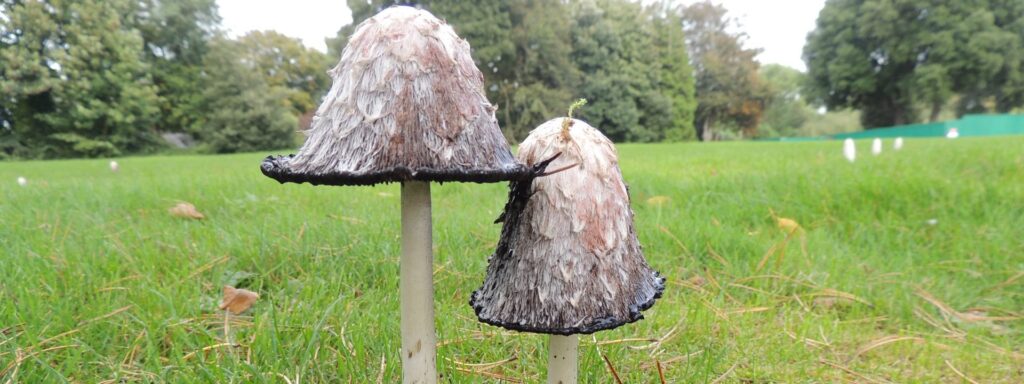
The Shaggy Inkcap can is also often called Lawyer’s Wig (because of its tiers of shaggy white scales akin to a lawyer’s wig) or maybe Shaggy Mane Inkcap.
Large, tall and upright with a cylindrical, white and fleecy cap which becomes black from the bottom upwards.
Southern bracket
The New Forest has a great number of very mature oak and beech trees which are in varying stages of decay, but all can be excellent hosts to this large perennial shelf or bracket fungus (Ganoderma australe).
It can attain a considerable size with its semi-circular shape often reaching well over 60 cm across when it is many years old. It grows out from trunks or stumps and amazingly, is nearly as hard as the wood from which it grows. It is probably the most common and largest of the six Ganoderma species in this country and can fruit on living or dead trees.
When first emerging from the wood, it appears as a very hard white lump which will, over several years, become completely brown on top, as it expands into the mature bracket.
Each year as it increases in size from a creamy white margin of new growth, a new ridge will grow, similar to the annual growth rings of a tree, but on the top surface. It tends to grow fairly low down, singularly or several in tiered layers. The cocoa coloured spores are often very visible because when they drop downwards from the bracket in huge numbers, and are dispersed by the wind, they may stick to the surrounding vegetation, tree trunk and even to the top of the bracket itself.
During the long lifespan of this fungus, the once standing host tree may fall over, so the fungus has the ability to produce a new shelf from its old one, to correct its orientation. This is vital if the fungus is to continue to disperse spores efficiently.
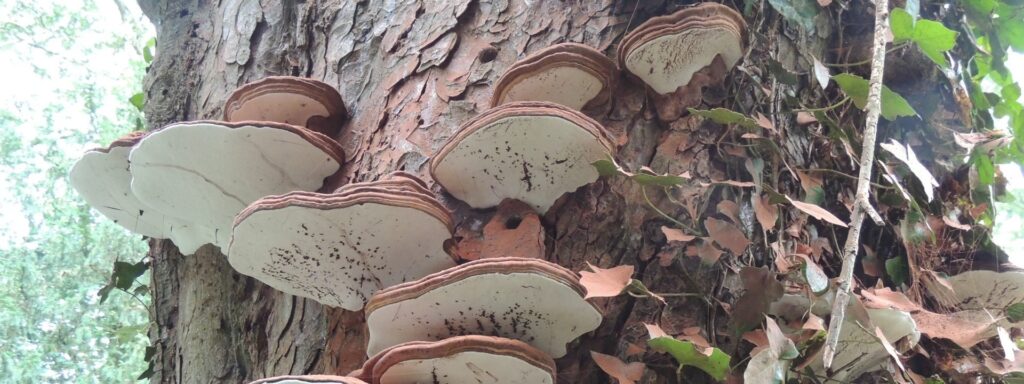
The upper surface is reddish brown and smooth, but becomes knobbly with concentric ridges. The underneath surface is white and composed of small pores, which when scratched will leave a dark brown mark.
Stinkhorn
If you happen to smell rotting flesh as you walk through the woods, it may well come from an aptly named Stinkhorn (Phallus impudicus).
The unpleasant smell is produced by the thick sticky brown mass which contains the spores, covering the top. Flies are attracted to it and the sticky substance sticks to their feet and thereby the fungal spores are transported to another location. It is a unique method of spore dispersal.
Stinkhorns can grow in groups or be solitary, and mature very rapidly, often overnight, although the entire structure is not very robust or long lasting and it may be a case of ‘here today and gone tomorrow’.
Whilst living in a somewhat less liberal Victorian England, Henrietta, one of the great Charles Darwin’s daughters, was horrified by the phallic looking Stinkhorn fungus. She did her best to tread on, and squash, all the ones she saw growing – or else she collected them in a napkin covered basket to bring them home to burn. She especially targeted those in their own garden to stop the maid servants in the house being influenced by them. She even singlehandedly began a campaign to have all fruiting bodies of the fungus removed from the English countryside.
Wood blewit
Wood Blewits (Lepista nuda) may often be found growing on the edges of the paths and gravel tracks that intersect the large areas of mixed woodland in the New Forest.
They are called Pied Bleu in France where they are also common.
They can be seen fruiting later in the year than many other mushrooms – so late autumn or well into winter, even into the New Year. They are not even greatly affected by a light frost, if they are sheltered by the trees and leaf litter, and they don’t seem to mind fruiting in slightly disturbed places either, so maybe that is the reason they appear beside paths and tracks.
They are stout robust mushrooms with a thick stem and bulbous base, a pleasant sweet aromatic smell and a cap as large as 15cm across. They are fairly common in the New Forest and usually grow in groups and sometimes in a definite ring formation, when they may be a spectacular sight.
When young, their identification can very easily be confused with another lovely lilac coloured Cortinarius species of mushroom, which is poisonous but is less common.