Moths
Moths
The New Forest has an estimated 1,460 kinds of moths, 58% of Britain’s 2,500 species.
An impressive range of uncommon species is included. In several cases they are only found in the Forest, which ranks as one of the top areas in the country with lepidopterists (those who study butterflies and moths).
Almost 900 are macro moths; the other smaller micro moths are not studied by some enthusiasts, but are gaining in popularity.
Moths are an important part of the New Forest’s biodiversity – and they provide a food source for many predators including bats, birds and spiders.
Many people run moth lights to attract moths and send in records to organisations such as Butterfly Conservation. While there is no problem running one in a garden, permission is needed from Forestry England if moth-trapping on Crown land. Why not join in Moth Night at the end of August each year and record your sightings?
Although some moths fly in the day time, many people notice large moths at night, even if they do not know what they are.
Or they observe large caterpillars in their gardens, or while out walking.
There are moths in all Forest habitats, with specialities which only live on heathlands, such as our only silk moth, the spectacular emperor moth. The woodlands are strongholds for other species, including the rare crimson underwing. Many moths live in the New Forest because the habitat management is right for them and because their preferred larval food is available.
Moths lay eggs that hatch into caterpillars (larvae), which are mostly plant feeders. The larva forms a pupa (sometimes within a cocoon), before the adult emerges.
Here we look at a few rare species that have a particular stronghold in the New Forest and some of the common species that you are most likely to see.
Reference: Brock, Paul D. 2011. A Photographic Guide to Insects of the New Forest and Surrounding Area. Pisces Publications, Newbury.
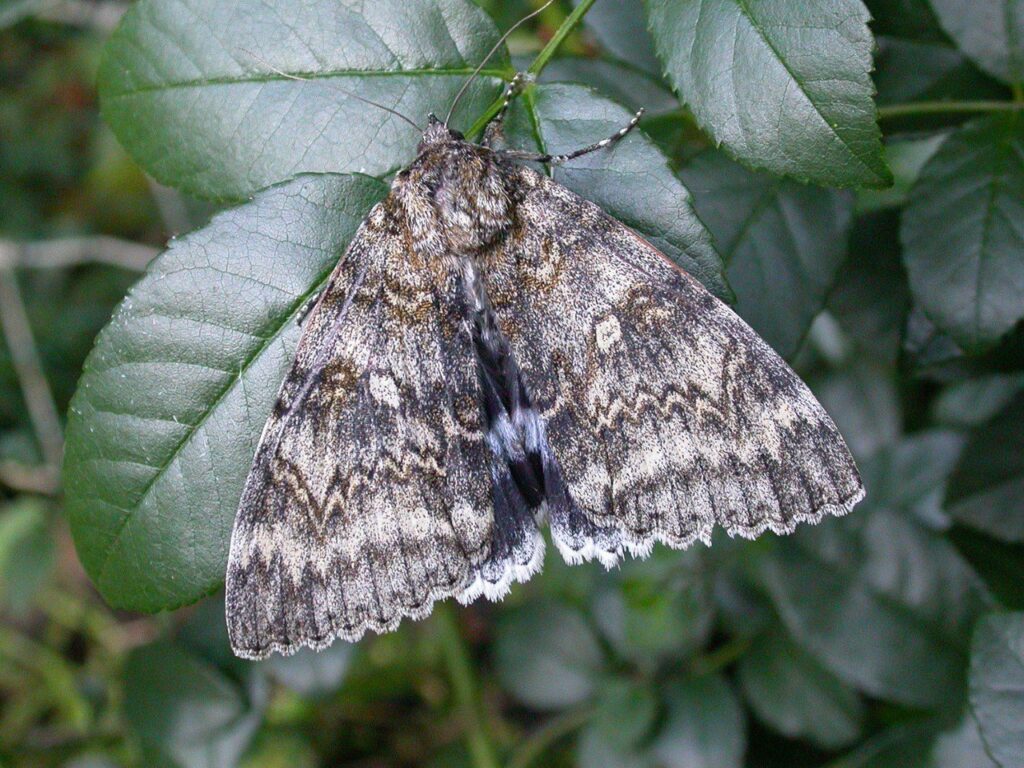
Clifden nonpareil
The rare Clifden nonpareil ‘catocala fraxini’ frequents aspen woodlands.
Thought to be an irregular rare migrant species from the continent, it is resident in parts of southern England, eastern England and the New Forest. They are attracted to lights at night.
Eggs overwinter. The larvae feed mainly on aspen.
Look out for these moths from August to October, for example they are often recorded in the Brockenhurst area, mainly in September, sometimes randomly seen resting on walls beneath lights.
The name Clifden nonpareil comes from the fact that it was first found in Clifden (now spelt Cliveden), Buckinghamshire. ‘Nonpareil’ is French for ‘without equal’.
Dark and light crimson underwing
Beautiful but rather rare – the dark crimson underwing ‘catocala sponsa’ and light crimson underwing ‘catocala promissa’ frequent more open parts of old oak woodlands, preferring large, mature oaks.
The dark crimson is mainly restricted to the New Forest, whilst the light crimson also occurs in Wiltshire with occasional records in Dorset.
They are attracted to sap runs on damaged trees, usually oaks, mostly at dusk, but sometimes by day (see goat moth). Just before dusk they may also fly high around oak tree canopies, or accumulate on trunks and branches.
Eggs overwinter. After feeding on oak buds and catkins in April, the well camouflaged larvae progress to oak leaves until early June.
Look out for these moths from late June to August. Dark crimson seldom appear before late July and if you find one; don’t forget to photograph it. They can be found at rest on tree trunks, but are extremely well camouflaged.
Conservation status: both Red list.
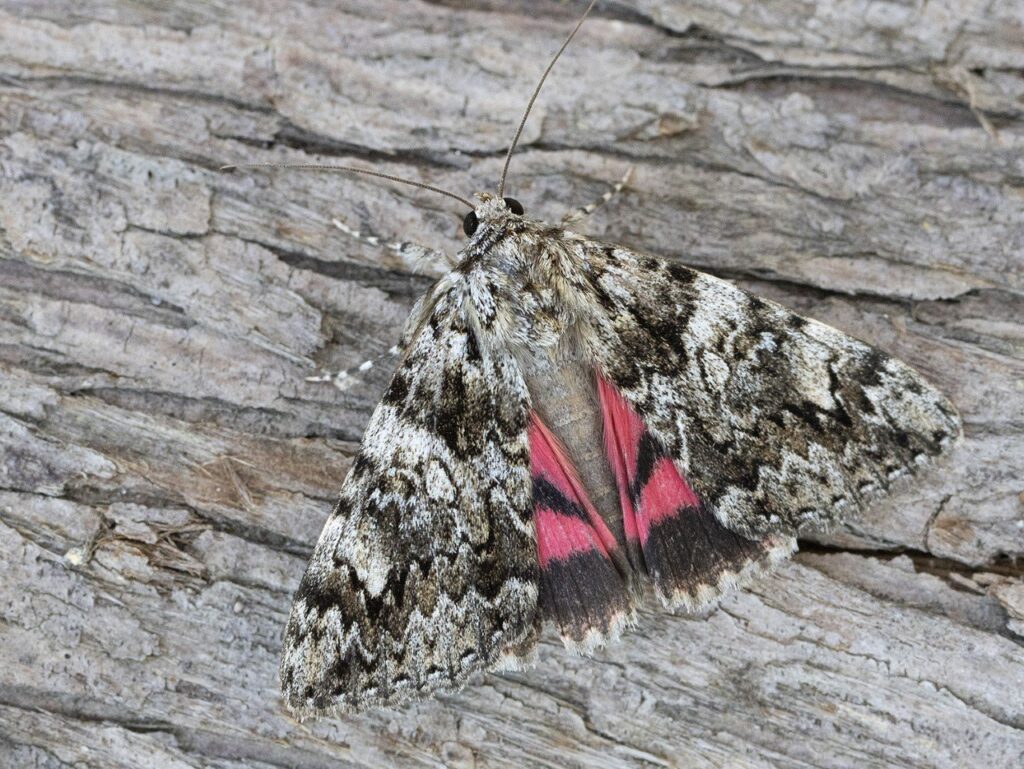
May be difficulty to decide which species if they do not reveal the hindwings, although the dark crimson underwing (wingspan 58-74 mm) is usually rather darker. The dark crimson has a ‘W’ shaped central black band, which is only slightly wavy in light crimson underwing (50-60 mm). The hindwings are sometimes opened when feeding at sap runs, or by way of defence, if disturbed.
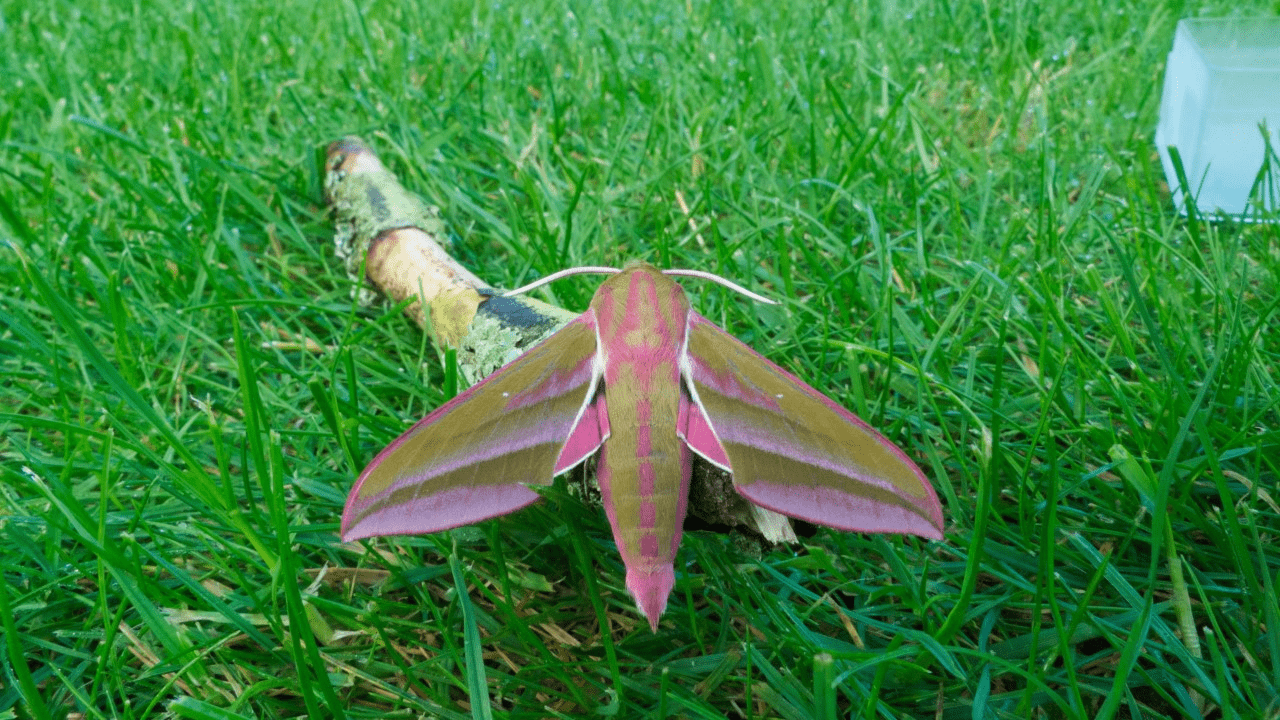
Elephant hawk-moth
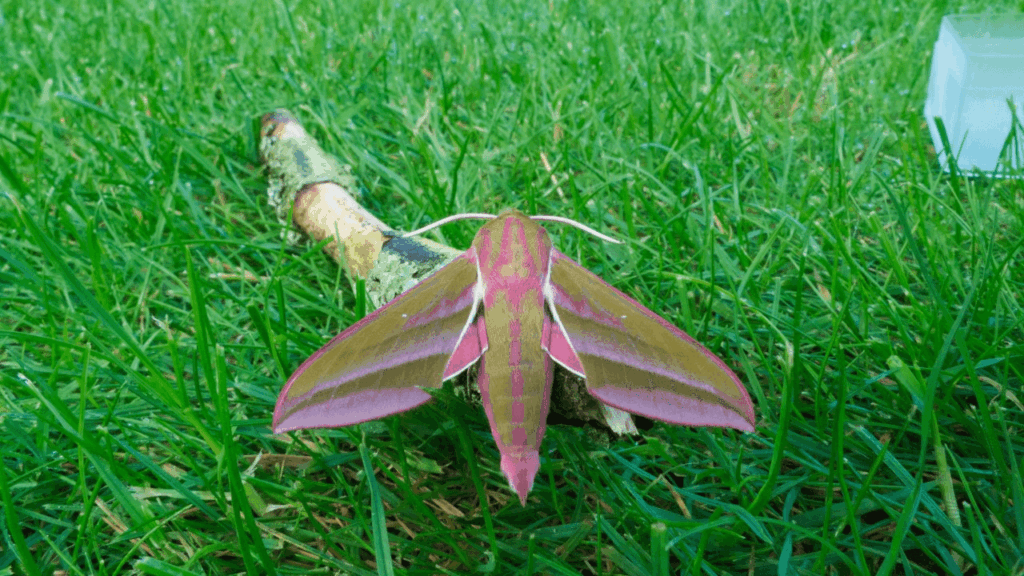
One of our most beautiful moths, the elephant hawk-moth ‘deilephia elpenor’ stands out from the crowd!
Found in woodlands, gardens and other habitats, adults may be seen nectaring on honeysuckle and rhododendron flowers at dusk.
However, you are more likely to see the huge brown or green larvae, which sport huge eye spots to warn off potential predators. When extended, they resemble an elephant’s trunk.
The larvae feed on willowherb, bedstraw and fuchsia leaves, overwintering as pupae formed beneath the soil.
Look out for these moths from mid-May to early August. They can sometimes be found during the day near lights. The larvae are easy to find feeding at night in August to September.
Emperor moth
Another beautiful moth, the emperor moth ‘saturnia pavonia’ is our only silk moth from the family saturniidae.
This was named after the ringed planet Saturn, as many species have large ringed spots on their wings.
All have larvae which spin cocoons, some being used to produce commercial silk, although they should not to be confused with the well-known silkworm moth from a different family, the bombycidae.
Fairly common on Forest heathlands, adults are seldom seen. However, if you are lucky enough to see a newly-hatched female, you might see a procession of the day-flying males attracted by pheromones released by the female or spot males flying on sunny spring days.
Females, however, only fly at night. More likely, the attractive larva will be seen on heather or bramble in summer.
Green when full grown (black early on), they wander on tracks before finding a suitable spot to spin their pear-shaped cocoons, usually on a plant stem.
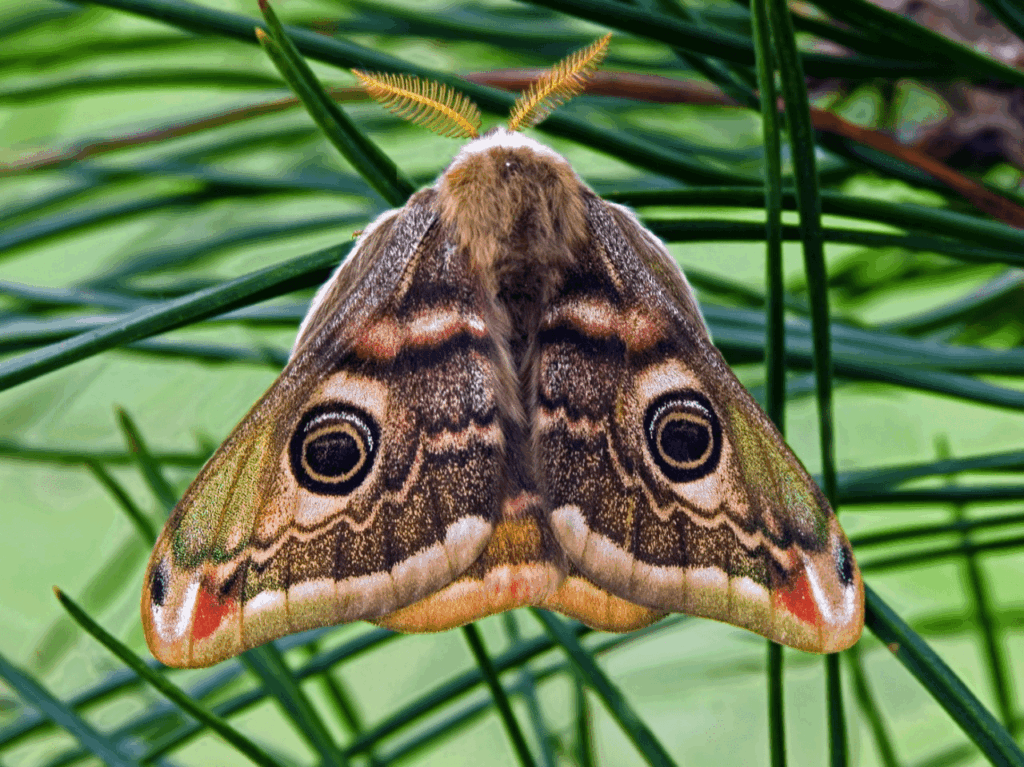
Look out for these moths from late April to mid-May. The larvae are likely to be seen when full grown about late August.
Wingspan: 55-85 mm. The male is smaller, with more brownish-pink forewings and orange hindwings. The antennae are feathery, unlike the female.
Fox moth
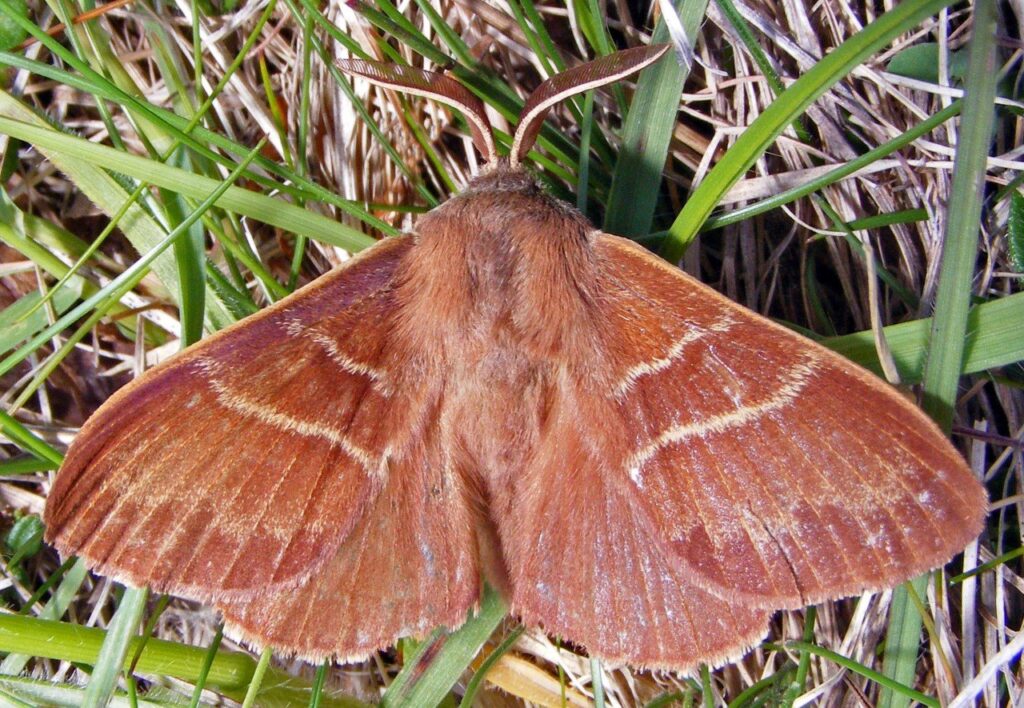
The robust-looking fox moth ‘macrothylacia rubi’ is nocturnal, but may be spotted flying at speed if disturbed during the day; males sometimes fly low down around midday and on sunny afternoons, searching for females.
They are common on New Forest heathlands and open areas where the attractive hairy brown larvae feed on heather, bramble and bilberry (initially they are black with orange bands).
When full grown, they wander on tracks before finding a suitable spot to hibernate, before spinning their cocoons in spring.
Look out for these moths from May to June.
Goat moth
The large goat moth ‘Cossus cossus’ has a fascinating life-cycle.
Occasionally found in more open habitats, such as woodland edges, gardens and parks, the larvae have powerful mandibles to burrow in the trunks of various trees. In the New Forest this is often oak, where the life cycle may take five years.
Sometimes sap exudes from larval exit holes in the trunks and this smells like fermenting alcohol. The nocturnal adults are seldom seen.
More likely, the huge larva will be seen wandering on tracks before finding a suitable spot to go underground, where they pupate in a strong cocoon the following May; sometimes this is formed in bark.
The goat moth-infected trees attract a wide range of interesting, often rare insects to sap runs, including parasites of the goat moth larvae.
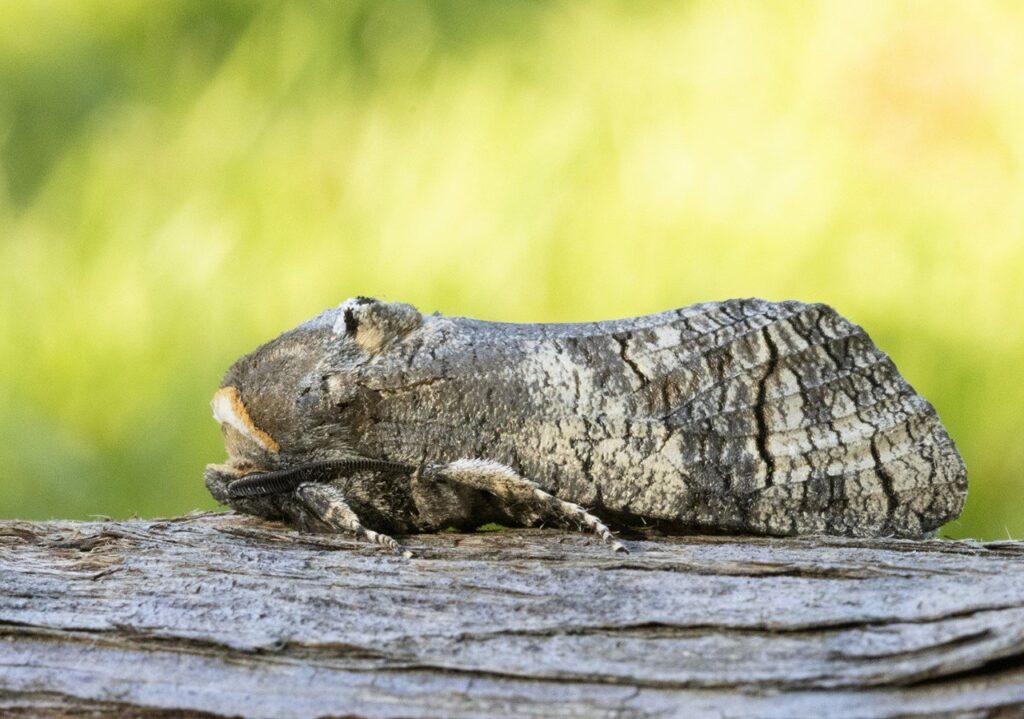
Adult moths fly in June to July. The full grown larvae exit trees mainly between August to October and the larval chambers are said to smell ‘goat-like’.
Wingspan: 68-96mm. Greyish brown wings with cross lines. The larvae reach c.100 mm.
Oak Eggar Moth
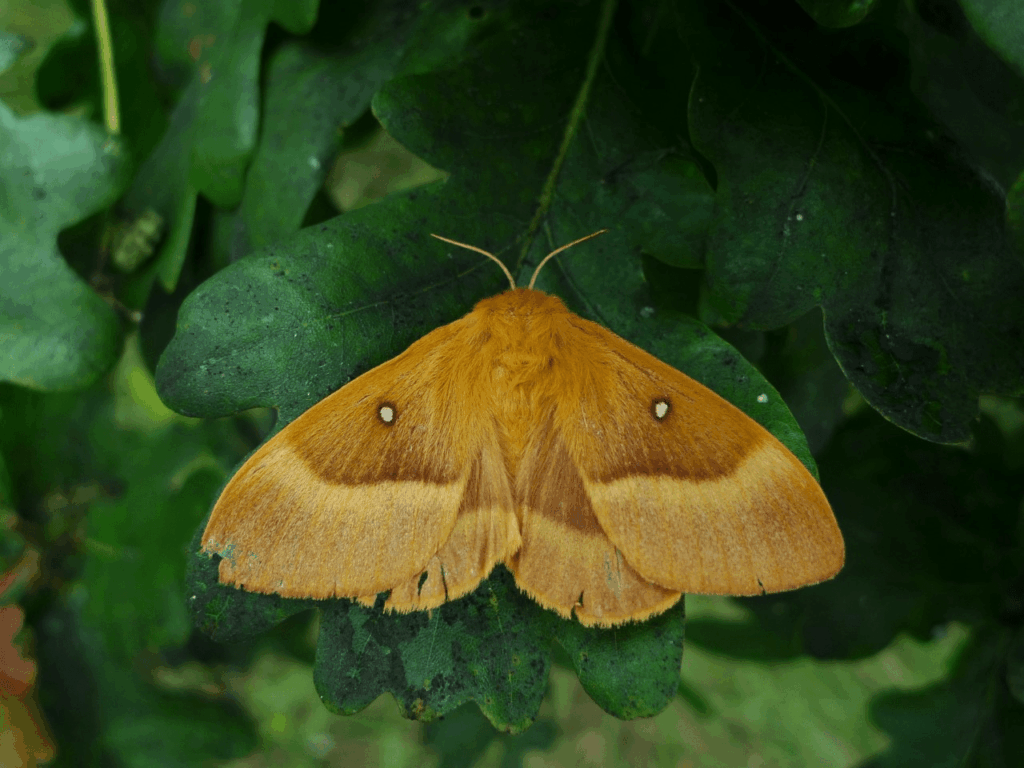
The oak eggar moth ‘Lasiocampa quercus’ is apparently named ‘oak’ because the cocoon is similar in shape to an acorn.
Fairly common on Forest heathlands, the swift-flying males are occasionally seen by day, in sunny weather.
Females are nocturnal and attracted to light at night, but when newly hatched can attract many males by releasing pheromones.
The large brown mottled, hairy larva feeds on heather, bilberry and bramble and also leaves of various trees.
Look out for these moths from July to August, resting in grass or low vegetation.
Pine hawk-moth
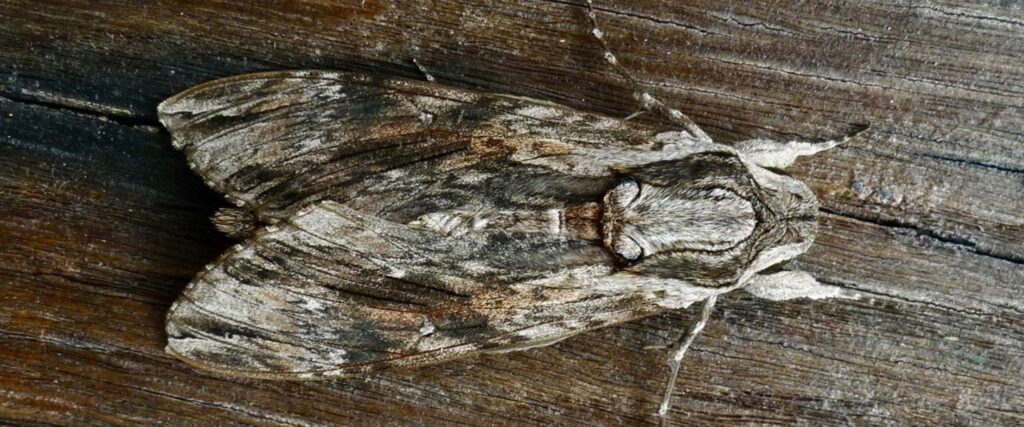
One of 18 species of British hawk-moths, the pine hawk-moth ‘Sphinx pinastri’ is not the most colourful!
However, it is a good example of what is feeding on pine needles in coniferous woodlands and gardens.
The attractive striped larvae eat Scots pine and Norway spruce needles. Adults feed on flowers after dusk, particularly honeysuckle.
Look out for these moths from May to early August.
They can sometimes be found resting during the day near lights, or you may notice the larva wandering off to pupate in August or September.
Speckled yellow
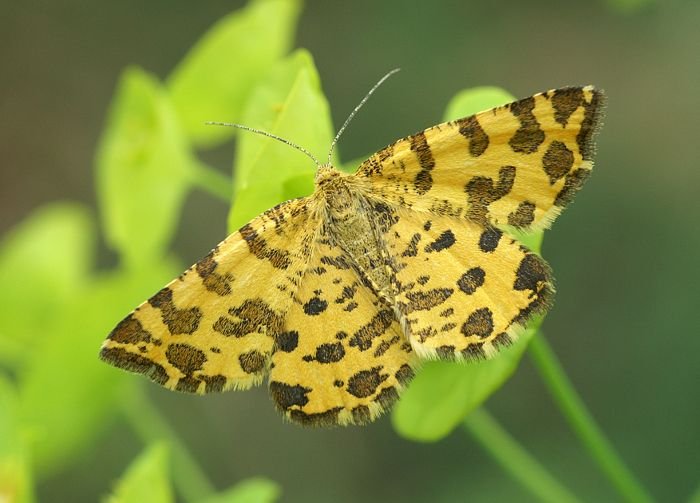
The stunning speckled yellow ‘Pseudopanthera macularia’ is familiar to many keen naturalists in spring.
Preferring open woodlands or scrubby grassland, adults are day fliers.
The larvae feed on wood sage, but also use white dead-nettle, woundworts and yellow archangel.
Look out for these moths along sunny woodland rides from mid-May to June.