
Dragonflies and damselflies
Dragonflies and damselflies
With clean streams, more wet bogs than anywhere else in north-west Europe and many ponds, the New Forest is a particularly important place for dragonflies.
Several species of dragonfly live only on heathlands and the New Forest holds all five of the heathland species occurring in southern UK.
Dragonflies and damselflies lay their eggs in water and the larvae develop in the water for a few years, where they are ferocious predators. Dragonflies are bigger and sturdier than damselflies and they hold their wings out like an aeroplane when landed. Damselflies are not so speedy and have more of a flitty flight. They hold their wings closed along their body or half-open when landed.
Dragonflies have a number of predators. The most important are fish, which eat the eggs and larvae, and birds, which eat the adults. However the most specialised dragonfly predator is the hobby. This summer-visiting bird of prey relies on catching dragonflies on the wing when it first arrives back in the UK in May.
Here are some details about the males of the rarer species of the New Forest and some of the common species that you are likely to see.
Azure damselflies
Azure damselflies are the most commonly seen blue damselfly. These little lines of electric blue are widespread throughout the New Forest and can be spotted in any area near water, especially small ponds, ditches and boggy areas. They also quickly colonise garden ponds. They are also common in the rest of the UK except Scotland.
You do not need to go to any special spot to see azure damselflies: the local pond, a pool on your local walk or even your garden are bound to hold some. The adults fly from May to the end of August. You will see them easily in sunny weather, but if it is cloudy look on the vegetation by the pond and you will probably see some settled there.
They are an electric blue damselfly with some black along the body, but definite identification requires a good look at the shape of the black mark just below where the wings join the body. This black mark is ‘U’-shaped. If you see blue damselflies at a small pond or ditch then they are bound to be this species.
Beautiful demoiselle
The beautiful demoiselle is common and widespread along streams throughout the New Forest. Some of the best streams can hold as many as one individual along every two metres of stream. The New Forest is this species’ stronghold in Hampshire. In the UK it is mainly restricted to the west of a line drawn from Kent to Liverpool.
Beautiful demoiselles are very sensitive to pollution. They breed in clean, fast-flowing streams with stony or gravelly bottoms, making the New Forest a perfect place for them. They can be found along most of the New Forest streams: try looking for them at Wootton Bridge car park, north of Sway, or Puttles Bridge car park between Brockenhurst and Rhinefield Drive. Sunny patches along wooded sections of the streams should produce these wonderful insects from June to the end of August.
Keeping streams clean and with areas free from shade is essential for the beautiful demoiselle. Occasional clearance work may take place along streams, but letting the ponies and cattle graze freely in the Forest also maintains habitat for them.
Blue-tailed damselfly
The blue-tailed damselfly is widespread throughout the New Forest, being seen in any area near water. It prefers habitats that are not acidic. It is common and widespread through the UK except the Scotland Highlands.
Blue-tailed damselflies breed in almost any waters, except fast flowing streams. They are more likely to be seen in ponds and ditches off the heaths than in waters on the heathlands of the New Forest that are too acidic for them. You may well see it anywhere in the New Forest, but areas such as Blashford Lakes (north of Ringwood) and garden ponds will hold high numbers. The adults fly from May through to early September.
The scarce blue-tailed damselfly is a rare species found in some of the boggy mires of the New Forest. It differs from the blue-tailed in having the blue going right to the end of the tail tip – not easy to see in the field.
Blue-tailed damselflies are all black with a bright blue tip to the tail. The only other common species which have this colour combination are the emerald damselfly and the red-eyed damselfly. The emerald damselfly differs in having a bottle green body and a second patch of blue on the body, near the wing bases. The red-eyed damselfly has burgundy red eyes.
Broad-bodied chasers
Broad-bodied chasers are common and widespread in the New Forest and can be seen wherever there is still water. They are common and widespread in the southern part of England and south Wales. Almost any still water of any size will hold a few.
Broad-bodied chasers will breed in any still water from the edges of large lakes to small garden ponds, but they do tend to favour the smaller bodies of water. They are often seen patrolling a territory of large puddles! Almost any small pool, pond or large puddle in the New Forest will have a male patrolling it from June to mid-August.
This is one species that easily and quickly colonises new ponds, so if you dig a pond in your garden these beautiful insects are bound to arrive in the first year or two. If you keep the pond free of fish then the dragonflies will breed successfully.
Common darter
This is probably the commonest and most widespread of the dragonflies in the New Forest and will be seen almost anywhere. It is also widespread and common throughout most of the UK except northern England and southern Scotland.
Common darters breed in still waters of any size, and are seen just about anywhere except in dark woodlands. A walk in any open, sunny part of the New Forest will produce this species, often in quite high numbers, at any time from late July through to the end of October. This is the latest species to be seen on the wing and can sometimes be spotted in December; in fact they only die off when cold weather kills the small insects that they feed on. So the milder the winter, the longer you will see common darters.
The darters are the red dragonflies and there are only two that are at all common in the UK – the common darter and the ruddy darter. These two are similar and the surest way to tell them apart is to get a good look at the legs: the common darter has black legs with a straw coloured streak down the side, but ruddy darters have legs that are all black. If you see a red dragonfly in the Forest it is most likely to be a common darter.
Emperor dragonfly
In the New Forest, emperor dragonflies can be seen wherever there is still water. The emperor is common and widespread in the southern part of England and south Wales. They are never seen in high numbers but patrol across expanses of water as singletons.
Emperors need still water to breed in and prefer a decent expanse of water such as lakes and large ponds. In the New Forest it is easier to find emperors at the larger ponds such as Hatchet Pond near Beaulieu or Eyeworth Pond near Fritham, but they can sometimes be seen at smaller temporary ponds or ditches. They are seen singly because the males are very territorial and will chase off a rival male that strays too close. These are dragonflies of mid-summer and it is best to look for them at any time from June through to mid- September.
Emperors are large dragonflies with a sky blue abdomen (tail) and a lime green thorax (body) and they are the only dragonfly to have this colour combination. A large blue-looking dragonfly that spends much of its time flying out over the water of a large pond or lake is bound to be this species.
Golden-ringed dragonfly
This wonderful species is widespread in the New Forest and fairly common along many of the streams. In the UK it is also found in Scotland, Wales and the south-west of England.
Golden-ringed dragonflies breed in small, open streams on heaths and upland areas. They require open, running water, but not in large volumes. The heathland streams of the New Forest are ideal and they can often be seen patrolling the streams in ones or twos. They can also be seen out on the open heath away from water as they search for food or fly from one stream to another. The adults fly in June, July and August. Many of the New Forest streams will hold them and it is difficult to select any particular site that is better than the rest.
Golden-ringed dragonflies are unmistakable. They are the biggest dragonfly we have and are banded black and gold, like huge thin wasps. It is wonderful to watch two males that meet along a stream. They will clash together, spiralling into the air before breaking off and continuing to patrol their chosen stretch of stream.
Large red damselfly
The large red damselfly is fairly common wherever there is water in the New Forest and can often be seen along streams or by ponds or bogs. It is widespread and common throughout the UK.
This beautiful little insect can be seen almost anywhere near water and breeds in bogs, pools, ditches, ponds and streams. The only habitat that it seems not to like is very fast-flowing streams. It is the earliest of the dragonflies and damselflies to appear in the year and can be seen in sunny weather from late April through to September. You are bound to see them at ponds such as Hatchet Pond, but many people often see them in their gardens – even if they have not got a pond.
Large red damselflies are in fact quite small. There are only two species of red damselfly in the UK and the large red is the common one that you will see almost anywhere. If you see a red-coloured damselfly in your garden, local stream or pond it will almost certainly be a large red. It can be told from the small red damselfly by its black legs. The legs of small red damselfly are red.
Small red damselfly
The small red damselfly is a New Forest speciality and the New Forest is its national stronghold. It is found throughout the New Forest, but only in a few other places in UK, such as Dorset, the Surrey heaths, Cornwall and west Wales. It is restricted to these areas because it is very choosy about its habitat.
The small red damselfly needs small, sunny, unshaded, shallow waters, such as acid bogs or pools with lots of plant life. The larvae need high water temperatures to develop and they are not very good at competing with other species. Tiny pools and even wheel ruts on heaths suit them well. To see this species you need to visit the boggier areas of the New Forest such as Latchmere Brook, near Frogham, or Crockford Stream, near Beaulieu. Choose a sunny day with little wind from June to late August.
Although a small and rare species, numbers in the New Forest can be quite high. Up to 500 were reported along a section of disused railway line near Burley in July 1993.
The small red damselfly is one of only two red-coloured damselflies in the UK. The small red has red legs and the large red has black legs. However, the habitat can help identify them – unless you are standing in a boggy area or small pool on the New Forest heaths you will only see large red damselflies.
Southern damselfly
The southern damselfly is a scarce species, even in the New Forest. Apart from one or two isolated colonies, it is only found south of the A31 in the streams between Burley and Brockenhurst and between Lymington and Beaulieu.
In the UK it is only found in the New Forest, along the Itchen and Test rivers in Hampshire, a few parts of Dorset and a few parts of Pembrokeshire in Wales. It is on the edge of its European range and is endangered throughout Europe, with the UK holding an estimated 25% of the world population. It is protected by law under the Wildlife and Countryside Act.
Southern damselflies breed in slow-flowing heathland streams and runnels with plenty of plant-life, but not shaded by trees and scrub. Away from the New Forest they have more recently been found breeding in chalk streams in Hampshire. One of the best places to see them is at Crockford Stream, just north-east of Pilley, near Lymington. The adults fly from May to September and are best seen in the middle of the day.
Identification is not easy. They are a blue damselfly with some black along the body, but definite identification requires a good look at the shape of the black mark just behind where the wings join the body. This black mark is a spot with a large ‘U’ balanced on top.
Altogether this is a rare species and the New Forest is one of the most important sites for it in the world.
Southern hawker
This is a fairly common and widespread species in the New Forest.
Southern hawkers spend a fair amount of time away from water, so this dragonfly can be seen almost anywhere in the New Forest, either at lakes and pools or out on the open heath or along woodland rides far from water. In the UK it is common and widespread south of a line drawn from Liverpool to Norfolk.
Southern hawkers require still water to breed in and can be found at any of the New Forest lakes or larger ponds. However they spend so much time away from water that there is no need to go to a specific site to see them. A walk in the woods any time from late July to late September will usually enable you to see one or two zooming up and down the rides.
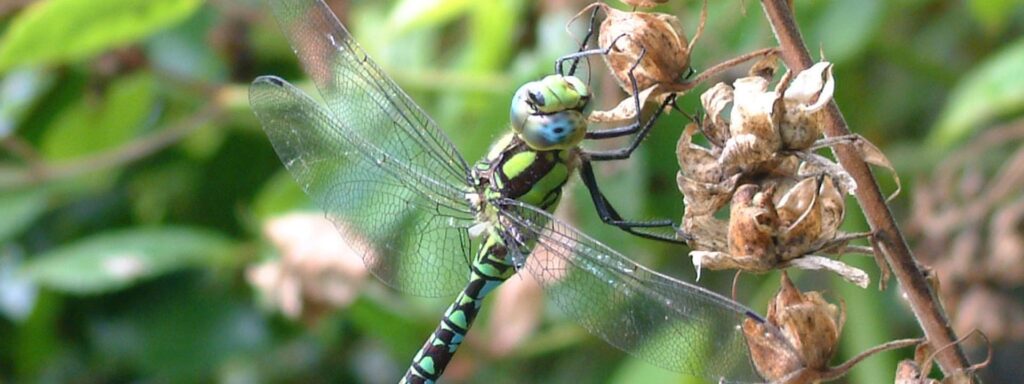
The hawker dragonflies are the spotty ones and the southern hawker is no exception, being dark with green spots that turn blue towards the end of the tail. They are similar to migrant hawkers but differ in having only one large spot at the end of the tail instead of the migrant’s paired spots, and in having a pair of thick yellow green stripes behind the head.