Butterflies
Butterflies
The New Forest boasts an impressive array of uncommon and special butterfly species.
Being so colourful, butterflies are the most noticeable of insects. A few species will only live on heathlands and the New Forest holds all of the heathland species that occur in the south of the UK.
Butterflies lay eggs that hatch into caterpillars. The food that the caterpillars eat varies from species to species, with many eating grasses, some eating the leaves of various plants and some of the blue species eating ant pupae and eggs in ants’ nests.
The range of habitats is important for the butterflies of the New Forest and there are some rare woodland and heathland species that depend upon the habitat management being just right for them.
Here we look at the rare species that have a particular stronghold in the New Forest and some of the common species that you are most likely to see.
Brimstone
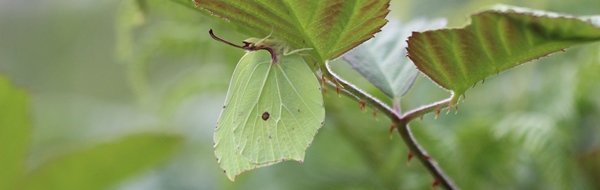
The brimstone is common throughout the New Forest and the rest of Hampshire. It is widespread and common in England, less common in Wales and Ireland and mostly absent from Scotland.
Brimstones can be seen in almost any habitat as they wander widely in search of mates and food. They lay their eggs on alder buckthorn trees in the National Park, which prefer damper areas, and they are quite fussy about exactly which tree they choose. They prefer trees in sunny positions, sheltered from the wind.
Being a yellow, or butter-coloured, fly, it is often thought that this species gave rise to the name ‘butterfly’. Unusually, brimstones spend the winter as an adult staying hidden in the shelter of ivy clumps and holly trees.
Brimstones can be seen just about anywhere in the National Park from April through to September, but they are most often seen in woodlands and areas with some trees. If you spend a sunny day in April, May or June in a New Forest woodland you will almost certainly see some brimstones.
Brown butterflies: meadow brown, gatekeeper & ringlet
These three species are all very common and widespread in Hampshire and the rest of southern UK. The gatekeeper and meadow brown are common throughout the New Forest, but the ringlet is scarcer.
Gatekeeper and meadow brown are open grassland and meadow species while the ringlet prefers woodland edges. They are more common among the fields, hedgerows and woodlands around the edges of the New Forest than in the central areas of heath and wood.
Almost any meadow will hold meadow browns, with gatekeepers along the surrounding hedgerows and ringlets in the adjacent woodland. All three will occur in open grassy areas within woods and all are on the wing in July and early August; the meadow brown can also be seen in June and September. The area around Roydon Woods near Brockenhurst is a good spot for them all.
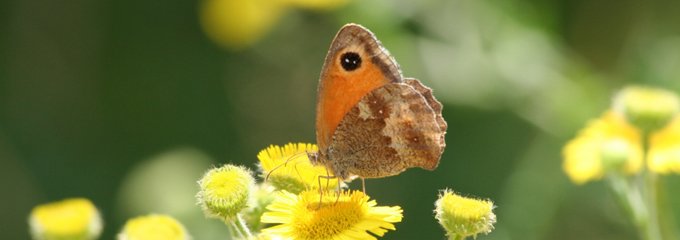
All the members of the brown family of butterfly have black eye-spots on their wings. Ringlets have chocolate brown upper sides with no orange and the underside is dark with black eye-spots ringed in cream. Gatekeeper and meadow brown are more similar to each other. The best way to tell them apart is to compare the amount of orange and brown on the upper side. The meadow brown has less orange and essentially looks brown with a patch of orange on the wing. Gatekeepers have more orange and the wings look orange with a thick brown border. If you get a very close view you can see that the gatekeeper has two white specks within the black eye-spot, while the meadow brown has only one.
Grayling
The grayling is fairly widespread on the New Forest and the Dorset heaths and is also found on the heaths of north Hampshire and southern England. Elsewhere in the UK it is found on the coast. However it is decreasing in many places, especially inland sites, and the New Forest is a particular stronghold for it.
Graylings are quite common on large areas of open heathland in the New Forest. They require dry, barren areas with broken ground of soil, sand or gravel and areas of grasses for the caterpillars. The management of the heaths to keep them open and free from invading trees, scrub, bramble and bracken is particularly important for this species. If an area of open ground becomes slightly shaded with scrub then the grayling disappears.
Look for it on any open heathland in July or August. It is best to slowly walk along gravelly tracks through the heather.
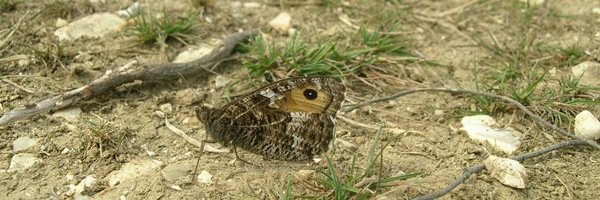
Old names for this species give a clue to how well camouflaged it is when it rests on the ground, always with its wings closed. Rock-eyed underwing and black-eyed marble are two of them. The underside of the wings is marbled with brown and grey and the upper wing has two black eye-spots. It is remarkable how this fairly large butterfly seems to disappear from view when it lands and closes its wings, even on an open track.
Orange Tip
This pretty spring species is fairly common and widespread in the New Forest. It is also common in the rest of Hampshire and throughout the UK.
Orange tips wander widely, but are more often seen in woods and shady areas. The females will only lay eggs on flowering lady’s smock or garlic mustard. Suitable food plants are recognised first by sight and then by chemically sensitive cells on her feet. She can even detect if a different female has already laid an egg on that plant and will move on.
Seeing the adults is quite easy: just choose a sunny day in April or May and wander about in one of the New Forest’s deciduous woodlands. Keen observers may also be able to find the eggs of this species by searching isolated plants of lady’s smock in sunny positions within about a metre of a hedge or woodland edge. If you look among the flower buds in April or May you will often find a bright orange, spindle-shaped egg.
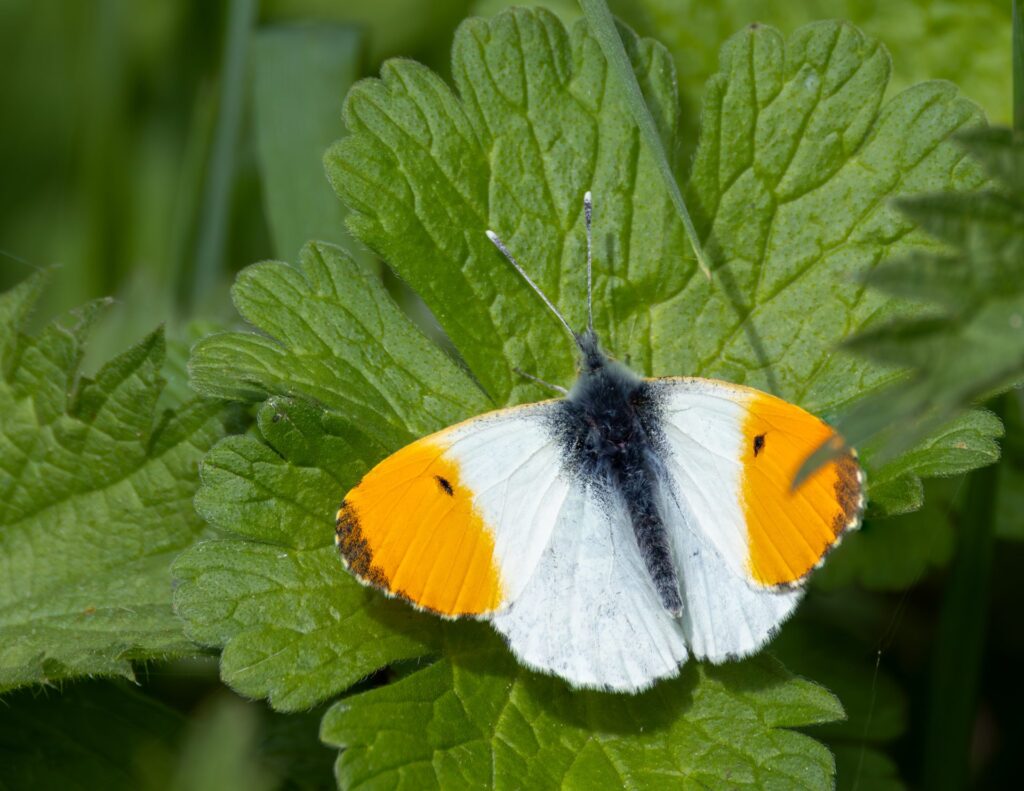
Male orange tips are unmistakable, being white with a bright orange tip to the wing. Females lack the orange, but can be separated from other white butterflies by the green marbling on the underside of the hindwing. This is easily visible if the butterfly sits still for a few seconds.
Landowners can help orange tips by leaving meadows with lady’s smock uncut until mid-July, by which time the caterpillars have left the food plants to pupate in nearby scrub.
Pearl-bordered & small pearl-bordered fritillary
These two very similar species have become very rare in southern Britain.
Both are now found in only a few woods in the New Forest and virtually nowhere else in Hampshire or Sussex. A century ago both species were very widespread and common in woodlands, but when coppicing was abandoned they decreased rapidly.
Both species require open sunny clearings within woodland areas and this habitat was provided by coppicing. Specific coppicing management is now carried out in order to help these butterflies. In the New Forest, scrub is cleared and trees are planted away from the edges of rides to keep them open and sunny.
Pearl-bordered fritillaries fly from early May through to mid-June and the woodlands around Standing Hat just north-west of Brockenhurst are the most reliable sites for them. Small pearl-bordered fritillaries fly a little later, from late May through to end of June, and are mostly to be found in woodlands around Holmsley.
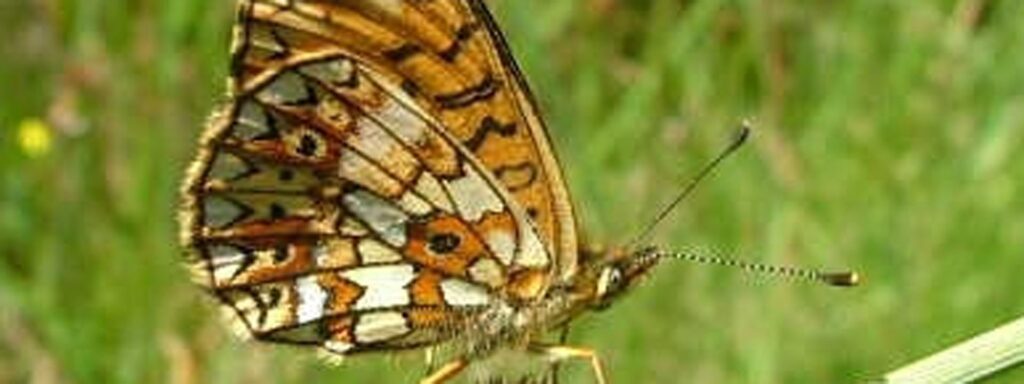
Fritillaries have orange checked markings with black spots on the upper side. These two species are the only ones to be found in Hampshire woods in May or June. They can be told apart by looking at the underside of the hindwing. Both species have a pretty mosaic of orange, golden and white cells. The small pearl-bordered has several white spots in the centre of that wing, whereas the pearl-bordered has just one.
Silver-studded blue
The silver-studded blue is a heathland specialty and the New Forest is one of its strongholds.
It is found throughout the New Forest but you will only see it in a few other places in the UK, such as Dorset, the Surrey heaths, Cornwall and west Wales. It is restricted to these areas because it is very choosy about its habitat.
In the New Forest, silver-studded blues are quite common on large areas of heathland. They require a habitat where there is plenty of young heather due to higher levels of grazing, clearance or a fire. The other thing they require is the black ant Lasius niger. The caterpillars secrete a sweet substance that the ants feed on; in return the ants look after the caterpillars, tending them, carrying them about and protecting them from insect predators. They even pupate in the ants’ nest: rows of silver-studded blue pupae have been found along the passages and brood chambers of ants’ nests in the New Forest.
The best places to look for silver-studded blues are on large areas of open heath with some damper spots during July and August. If you see a blue butterfly follow it and wait for it to land, then creep up slowly for a closer look. Sudden movements will scare them off.
Males can be told from any other blue by being bright blue and having a band of black at the edge of the wing. However any blue butterfly seen in numbers on the open heath is almost certainly this species.
Silver-washed fritillary
The New Forest was once famed for its silver-washed fritillaries.
According to one writer were seen in such profusion that ‘it was common to see 40 or more assembled on the blossoms of a large bramble bush’. These days it is fairly widespread and common in many woodlands of Hampshire, but the New Forest remains a stronghold for it. Although it decreased greatly during the 1900s it appears to be on the increase again.
Silver-washed fritillaries prefer mature, sunny woodland with an open tree canopy; old woodlands of the New Forest are ideal for it. Unlike the other fritillaries they will usually lay their eggs on the trunks of mature trees, often choosing the shadier northern side.
You can easily find this beautiful butterfly by visiting sunny spots in any of the New Forest deciduous woodlands during July and August. Sit beside a patch of flowering bramble and wait. On a sunny day you should see several before too long.
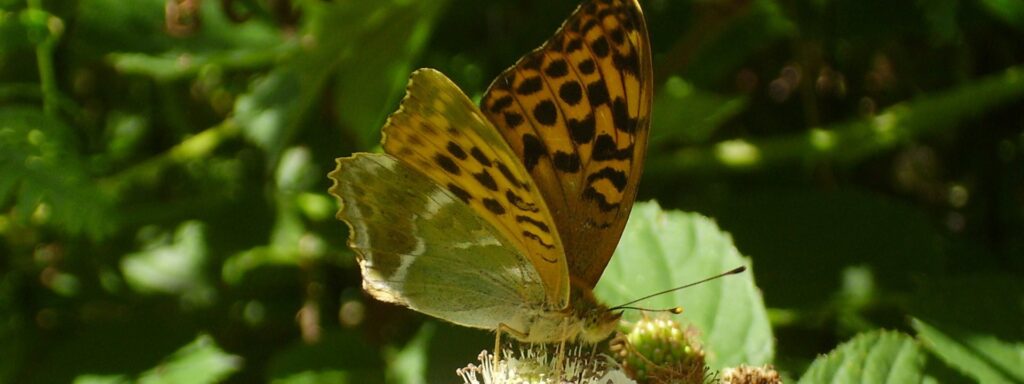
Silver-washed are the largest of the fritillaries and one of the UK’s largest butterflies. The upper side is orange with black spots and streaks and the underside is a beautiful olive green streaked with lines of silver.
Speckled wood
The speckled wood is common throughout the New Forest and the rest of Hampshire. It is widespread and common in England, lowland Wales and Ireland, but absent from much of Scotland except the wooded west and north coasts.
The speckled wood is a woodland butterfly and is commonly seen in sunlit glades or dappled shade along rides or even deep in a wood. They will also be found along lanes, hedgerows and among scrub, but never right out in the open. Unusually for butterflies, the speckled wood does not often feed on flowers, but takes honeydew which aphids produce in the treetops. They will consume nectar on flowers early and late in the year when aphid activity is low.
Finding speckled woods is very easy. They can be found in almost any area with some trees; if you visit an area of woodland on a sunny day and wander around rides and tracks you are bound to find some. The adults fly at any time from spring till autumn; late April, August and September are the best months to look.
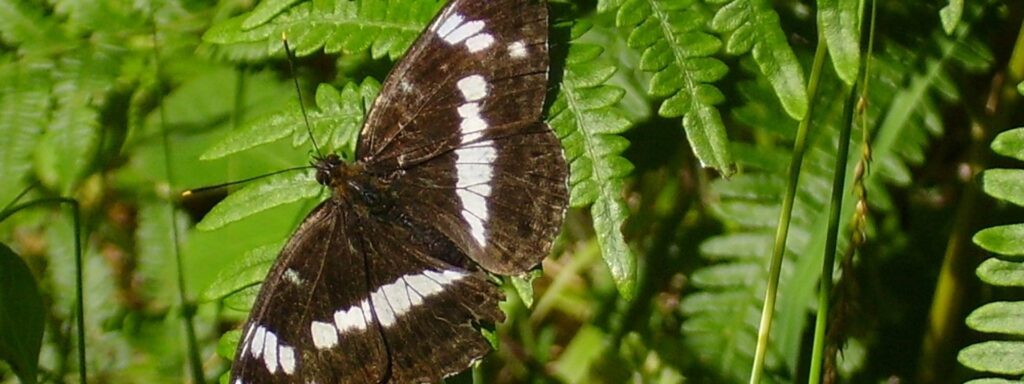
White admiral
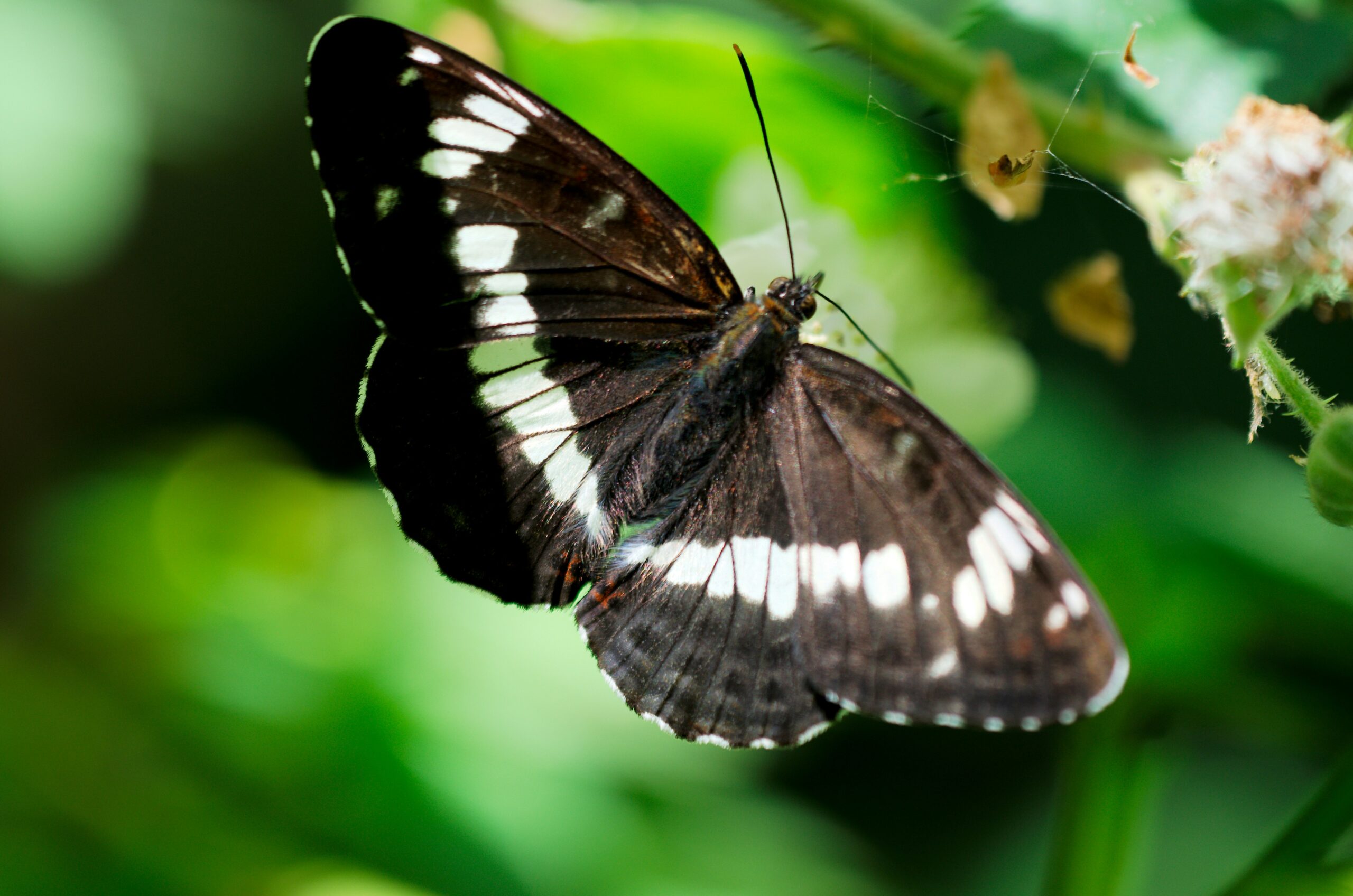
This uncommon species is found in the larger woodlands of the New Forest, particularly in the eastern half.
In the UK white admirals are only found in England and they occur in almost all the southern counties, although Hampshire, Sussex and Surrey are the species’ strongholds.
White admirals breed in the majority of the deciduous woodlands within and around the National Park. They lay their eggs on honeysuckle leaves, which are common in these woodlands. The adults fly in July and August and the best place to look for them is along sunny rides in the deciduous inclosures. They have a strong flight and will sometimes come and investigate, or even mob, people walking through their territory.