

Beetles
Beetles
There are a remarkable 2,600 kinds of beetles in the New Forest National Park.
This includes a number of uncommon and special species, with some only found in the Forest.
Beetles are spread across all the area’s habitats, with some specialists living on heathlands, but many living in woodland. These are saproxylic species, those dependent on the fungal decay of dead woody tissues and in some cases, these rare species only occur in ancient woodlands.
The range of habitats is important for the beetles of the New Forest and the way we manage the land is important for beetles to thrive. Here we look at a few rare species that have a particular stronghold in the New Forest and some of the common species that you are most likely to see.
Brown diving beetle
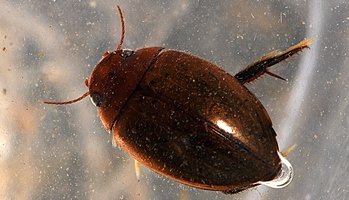
Most small water beetles are black, so the brown diving beetle Agabus brunneus stands out.
These elusive insects have been recorded from a few New Forest heathland streams including Widden Bottom (otherwise they are restricted to west Cornwall and Dorset heathlands). Peak time is about September but in theory the beetles can be found all year round, although there are only five records in the Forest from 2001-2011. Even some specialists have failed to locate specimens year after year!
The ideal habitat is a stream surrounded by gorse and heather, with long marginal vegetation trailing into the water combined with water which is intermediate in flow between a riffle and a pool. The streams dry up at times and in these conditions, these beetles burrow deep into the gravel, making them even more difficult to locate.
Flame-shouldered blister beetle
The flame-shouldered blister beetle sitaris muralis is an endangered species rediscovered in the UK in New Forest in 2010 after an absence of 41 years.
Since then sightings have been reported elsewhere in Hampshire, Dorset and other parts of southern UK.
These beetles are parasites in the nest of the fairly common Hairy-footed Flower Bee Anthophora plumipes which nests in old brick walls. In spring these bees (females all black) can be seen hovering over garden flowers and are sometimes mistaken for bumblebees. Nests are often entered via what resembles ‘bullet holes’ drilled in the brick, often above head height.
What we know about the life-cycle of these beetles is mainly gleaned from Fabre (1857):
“The eggs are laid near the ground nests of the bees during late summer and hatch in the fall. The larvae hibernate and become active the following spring, climb the plants to the flowers, and await the visits of the female host bees to which they attach themselves to be carried to the nests being constructed by the bees in the soil. Upon arrival there the triungulins leave the adult bees to seek out their eggs, which are consumed and which enable the predators to transform into apodous eruciform larvae. These latter consume the stored honey, which enables them to develop fully and to transform into prepupae which hibernate the second winter. The following spring pupation takes place and the adult beetles emerge in the summer of the second year preparatory to mating and laying their eggs as indicated above”
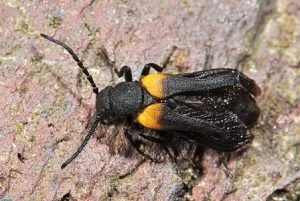
Look for the beetles resting on any old brick walls in late July or throughout August, or they might be on the pavement nearby; they are poor fliers and clumsy when walking. In defense, they curl up in a ball and play dead; it is likely that the bright orange on the wing cases is a warning colour.
If you find one, please photograph it, if possible, and report it to Buglife.
Great diving beetle
The great diving beetle dytiscus marginalis is one of our largest water beetles, although there are several closely related species.
This versatile and common beetle is found in still or slow flowing waters, occasionally fast flowing. Most likely in small ponds, adults can be found all year round but peaks are usually in May and September.
The larvae are carnivorous, feeding on a wide range of aquatic life; they are ferocious hunters. When ready to pupate, they crawl out of the water to look for a suitable site in damp soil, perhaps several metres from the pond. Adults hatch around September and overwinter at the bottom of the pool until spring, when they look for a mate and lay eggs.
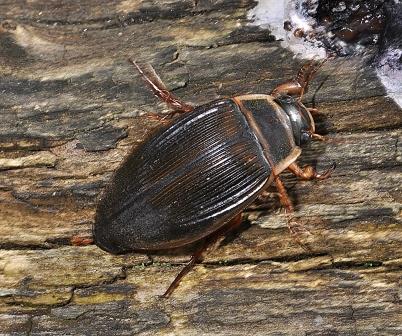
26-32 mm long, black with a continuous yellow margin around the thorax and wingcases. The underside is yellow. Try a pond-dipping event in the area sometime e.g. Blashford Lakes, and this is one of the likely finds.
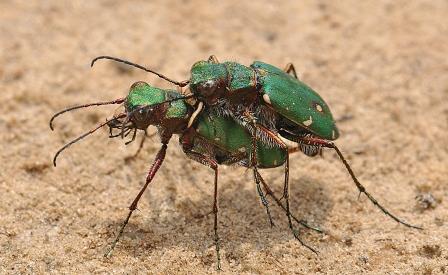
Green tiger beetle
The green tiger beetle cicindela campestris is common in much of Britain and often spotted by walkers along tracks in dry New Forest heathlands and, to a lesser extent, in woodland.
These powerful hunters are carnivorous, flying in strong sunshine from March to October, but only in numbers up to July. They have long legs to assist with fast running, large eyes and jaws to spot and devour invertebrate prey, fully warranting the name ‘Tiger’.
The larvae dig pits along tracks, in order to set a trap for unsuspecting invertebrates, before pouncing with strong jaws. They typically feed in rotting wood debris in cavities and hollows.
Watch out for these beetles on tracks or more likely, they will be wary of you, flying up from a track and alighting further along.
Noble Chafer
Another beautiful but very rare beetle is the noble chafer gnorimus nobilis.
These sun-loving insects have been recorded in the New Forest from late June to July on elderberry and hogweed flowers, mainly in the vicinity of Brockenhurst and Lyndhurst, even at the side of the busy A35.
The grubs (larvae) develop for two to three years in decaying old but still live trees, possibly oak and beech in the Forest, but often in old orchards (apple, cherry, plum) in its limited range elsewhere in England. They typically feed in rotting wood debris in cavities and hollows.
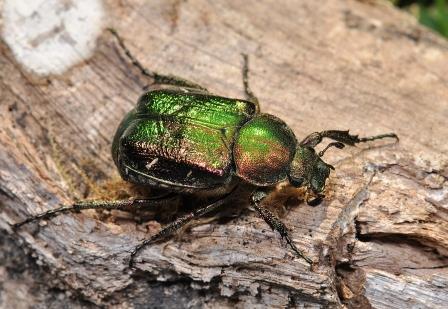
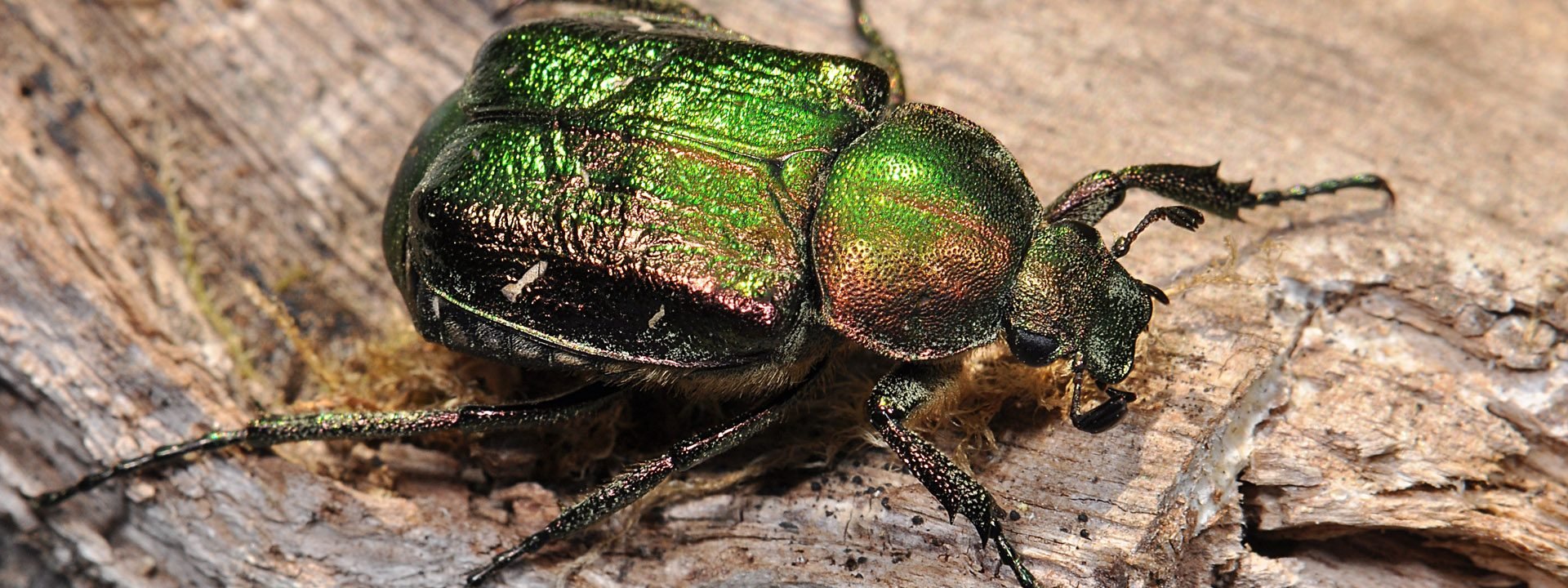
15-20 mm long, metallic green, speckled with white, in certain light the body can flash copper, gold and even violet. It could easily be confused with the similar, common, Rose chafer, but the Noble chafer is less smooth and round than the Rose chafer, with a small triangular area between the wing cases (much longer in the Rose chafer).
Rose chafer
They have a fascinating association with ants in that adults have been seen in Parkhill Inclosure, being escorted by several worker ants and lowered into the nest of Southern wood ants Formica rufa, whilst the main army of ants is tearing other insects apart for food. It is presumed the larvae help keep the nest clean, hence they are tolerated.
One of our most beautiful beetles, the rose chafer cetonia aurata is a common sun-loving species in the New Forest (and in Britain) from May to September and beyond
It is often seen on flowers such as bramble, elderberry, gorse, hogweed, privet and rose. It is found in the Open Forest (for example, at the Reptile Centre near Lyndhurst) as well as gardens.
In the Forest woodlands you might see a flash of green speed by and if lucky, spot it landing on flowers or an old stump. They are noisy and fly in a similar manner to bumblebees. The grubs (larvae) develop in the rotting wood of old stumps or on decaying leaves and vegetable matter, developing over two to three years.
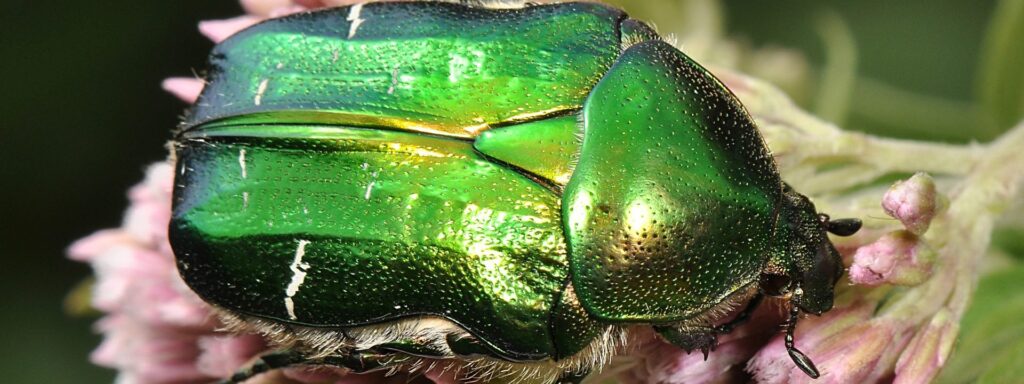
Maintaining habitat for insects which are associated with deadwood is important. Leaving a stump in the garden might help beneficial beetles such as Rose chafers brighten up our lives. The larvae are the equivalent of earth worms and help to make good compost.
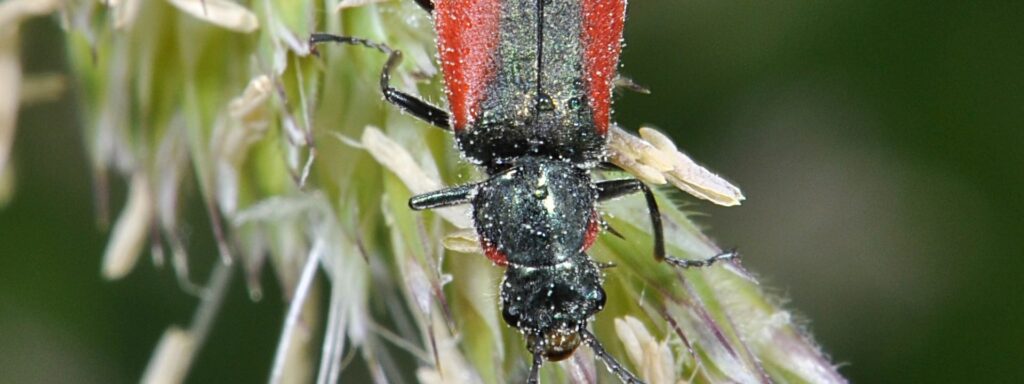
Scarlet malachite
Another stunning, rare beetle with an unusual but little understood life history is the Scarlet malachite malachius aeneus.
Sadly, these sun loving beetles have only been recorded at a few sites in Britain since 2000, one of the strongholds being villages in the New Forest: North and South Gorley, and also a major site only discovered in 2011, Furzey Gardens, near Minstead.
They have been recorded in the Forest mainly in June, in grassy areas such as flower rich meadows, near thatched cottages. They eat pollen from grasses, plantain or flowers, including buttercups, but sometimes devour slow moving invertebrates.
The larvae are predators. It is believed that this species prefers old agricultural practices, such as the ecosystem that develops in old straw and hay, similar to changes in thatch.
Stag beetle
The stag beetle lucanus cervus is Britain’s largest beetle, now mainly restricted to parts of south and south-east England.
Adults are found in late May to the end of August in gardens, wooded parks and woodland, near decaying tree stumps (apple, elm, lime, beech and oak).
The New Forest is one of the strongholds for this species; with males often attracted to lights at night. Searching around lights in early morning in areas like Brockenhurst or Sway in June may result in the sight of several lying on, or walking on nearby pavements (some injured after collisions with motor vehicles).
Although looking rather fearsome, males are quite harmless; the females can, however, give quite a nip if handled. The size of the antlers appears to have little influence on mating success. Males fly to females after dusk, often in numbers, which may result in rarely observed fights between rival males. The antlers are used in these fights, with the winner throwing the loser onto the ground; several efforts may be made before a male has the right to mate with a female. Whilst fighting, they risk another male walking away with the prize.
The female lays eggs singly, near rotting wood and the life cycle takes three to four years, the larvae living in the stumps. The female may either die underground after laying its eggs, or around ground level.
Noisy in flight, stag beetles are sometimes rather clumsy landing; if they land upside down or topple over, they struggle to right themselves. During the brief time in the adult stage (a few weeks), they are sometimes seen feeding on sap oozing from trees, for example from ‘Goat moth’ trees. These are live trees (often oaks) damaged by Goat moth larvae feeding inside; they have conspicuous exit holes and the sap from the tree attracts various insects.
In European folklore, the stag beetle was a symbol of evil and bad luck; medieval peasants believed they summoned thunderstorms.
Maintaining habitat for insects which are associated with deadwood is important. Leaving a stump in the garden might help Stag beetles find suitable habitat. They have a hard life, vehicles contribute to the death of these insects, as well as people accidentally treading on adults on the pavement; other predators include foxes and hedgehogs, also magpies, which eat the abdomen and leave the rest.