Woodland Flowers
Woodland Flowers
Woodland flowers bring seasonal colour and life to the New Forest’s ancient woodlands. From early spring blooms that carpet the forest floor to shade-loving plants that thrive beneath mature trees, these flowers take advantage of the changing light throughout the year. Their presence is a sign of long-established woodland and healthy soils.
Many woodland flowers rely on the stable conditions created by ancient trees and undisturbed ground, making them particularly sensitive to change. Protecting these plants helps preserve not just individual species, but the delicate balance of woodland habitats that support insects, birds and other wildlife across the Forest.
Bastard balm
Bastard balm is a rare plant in the UK. It only occurs in Cornwall, Devon, parts of south-west Wales and the New Forest area.
In the New Forest it is now quite scarce with just a handful of sites and only grows in rides and small clearings in ancient woodlands, often near streams.
Bastard balm flowers later than many other woodland flowers and is best seen in June. The rides in Wootton Coppice are one area where it is seen most years. It can be difficult to find, so the search adds to the thrill of finding such a rare flower!
Bastard balm usually grows to between 6 and 1 cm tall. It has nettle-shaped leaves in opposite pairs up the stem. Just above the leaves are rings of the flowers, which are up to four centimetres across and white with large pinkish blotches on the lower petal.
Bluebell
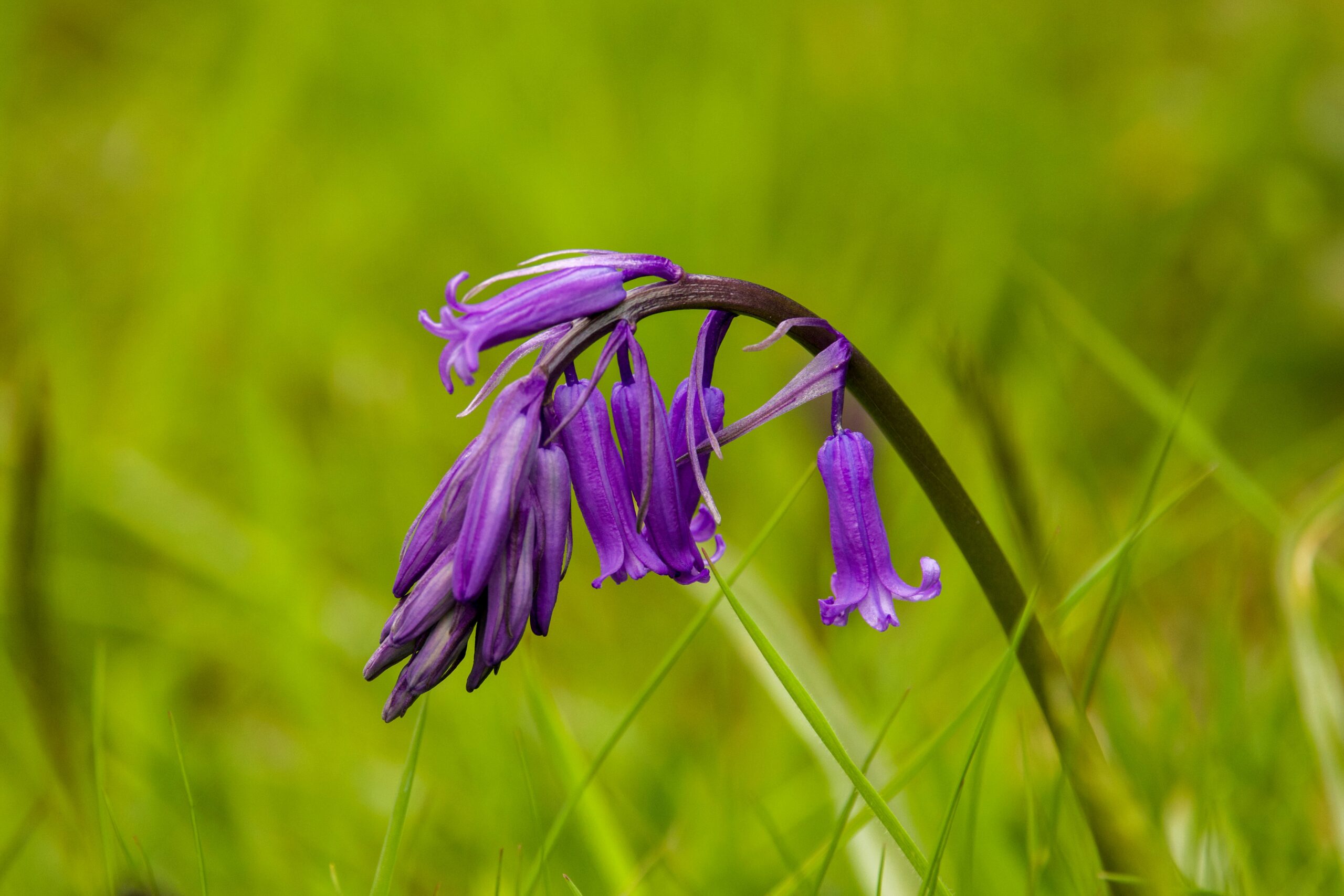
Probably the best known and loved of our woodland flowers, bluebells are widespread and relatively common throughout the UK.
However, almost half the world’s bluebells are found in the UK as they’re relatively rare in the rest of the world.
In most of southern England, they dominate large areas of ancient woodland. In the New Forest they also occur under areas of bracken, where the bracken acts like a woodland canopy. Many may not realise it is against the law to intentionally pick, uproot or destroy bluebells.
There are actually only a few woods in the New Forest where you will see swathes of bluebells, and these are in the drier, well-fenced inclosures. Elsewhere, in places open to commoners’ stock and wild deer, bluebells tend to occur only in small numbers. It is not the grazing but the trampling of the leaves by the animals’ hooves that reduces the bluebells’ ability to obtain the nutrients they need to sustain their underground bulbs through the long autumn and winter period.
The best place in the New Forest to see bluebells is Ivy Wood, just east of Brockenhurst along the B3055 towards Beaulieu. You will need to park in the car park and look a little way into the woods — they cannot be seen much from the roadside. Late April is usually the best time for them.
The Spanish bluebell is a non-native species that has escaped from cultivation and gardens and now hybridises with our bluebells. In some bluebell woodlands all the individuals are now hybrids and the concern is that our native bluebell could be threatened. Thankfully, this does not seem to be happening so much in the New Forest area. So if you are planting bluebells, ideally make sure it’s the English bluebell.
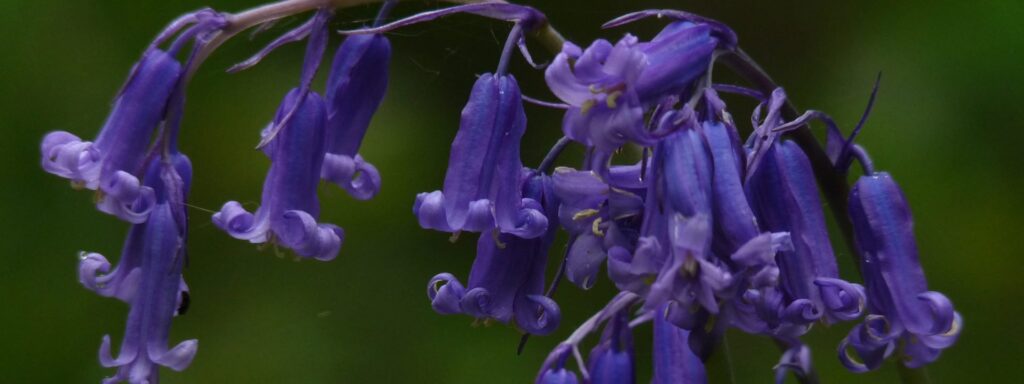
Bluebells can be confused with the Spanish bluebell. The native bluebell has flowers hanging down and all on one side of the stalk and the anthers inside the flower tube are creamy-coloured. Spanish bluebell has flowers all round the upright stem and the anthers in the flowers are usually blue.
Butchers-broom
Butchers broom is uncommon in southern UK and gets rarer the further north you go. In Hampshire it is widespread in the southern half but rare on the chalk.
Butchers broom is known as an ‘ancient woodland indicator’. This is because it doesn’t colonise new habitats or spread easily to new woods; where it is growing, the wood has usually been there for a very long time. The New Forest has many ancient woods and especially high numbers of butchers broom plants. Look beneath the deciduous trees, even in the more shaded areas.
There is a lot of butchers broom in the deciduous woods at Linwood to the north-east of Ringwood – it can even be spotted from the roadside.
Butchers broom is quite unlike any other British plant. It is a short evergreen bush growing up to about two feet high and all the leaves end in a pointed spike; one of its old English names is ‘knee holly’. In early spring, the tiny, pale green six-petalled flowers sit in the middle of the leaf and show that these leaves are, technically, flattened stems.
Butchers broom was used to scour butcher’s blocks until the nineteenth century. The spiky leaves seem ideal for getting into the cuts of old wooden blocks to clean them.
Foxgloves
Foxgloves are very common throughout UK in many habitats on acid soils. They occur throughout Hampshire and the New Forest.
In the New Forest they are commonest in woodlands, especially open areas or in places that have recently been disturbed, and they can be seen in flower by taking a walk through almost any areas of woodland during June.
The foxglove is responsible for modern medicine: in the late 17 s William Withering studied the effects of the leaves on patients and found that it slowed and strengthened the heartbeat, but the dosage was critical and only small amounts could be given. Later, the active properties including digitoxin were isolated and are still used today in the modern medicines for heart stimulation.
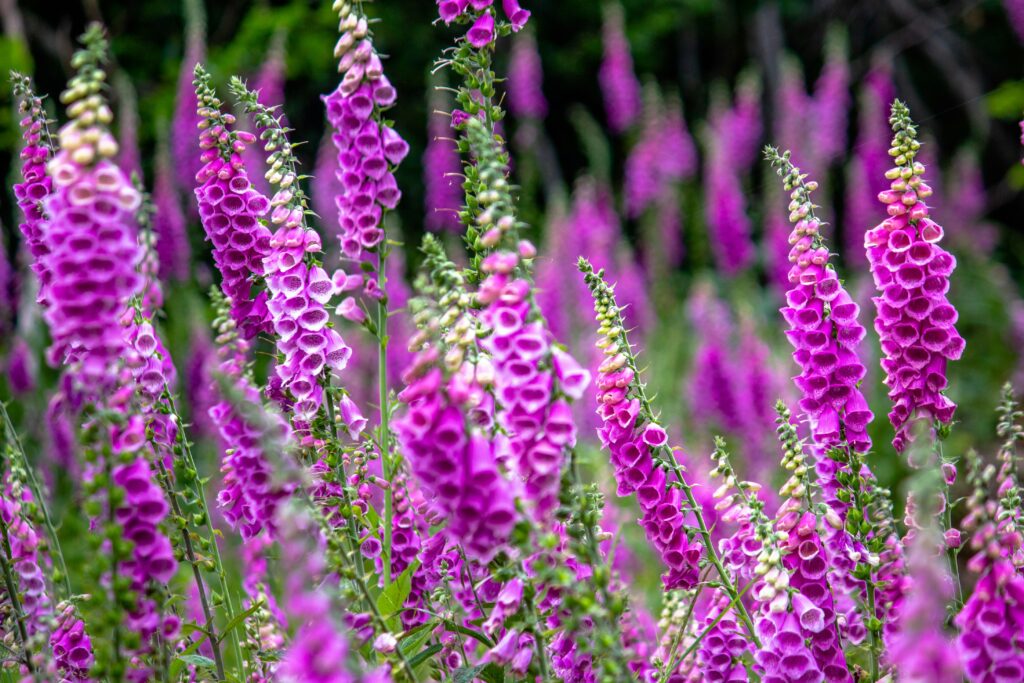
The tall spikes of purple / pink trumpet-shaped flowers are very characteristic and well known – no other species looks like the foxglove!
Lesser celandine
Lesser celandine is a very common and widespread species throughout the UK and the New Forest is no exception.
It can be found in grasslands, roadside verges and commons, but its true home is woodlands, where it is most frequent along the sunnier ride sides and the edges of the woods.
Being so common there is no one particular place that one should go to find it – almost any hedgerow, road verge or small woodland will have some. The better places will be the drier broad-leaved woodlands in the New Forest. It is not so common in very wet woodlands and uncommon in the darker coniferous woods. It flowers in spring: April and May are the best months to see it.
A local name for lesser celandine is ‘spring messenger’ on account of its relatively stable early spring flowering time. The 18th century naturalist Gilbert White noted that the average first flowering of celandine around his Hampshire home was 21 February. In the late 19th century John Hopkinson gave the same date and it is still the average time of first flowering today.
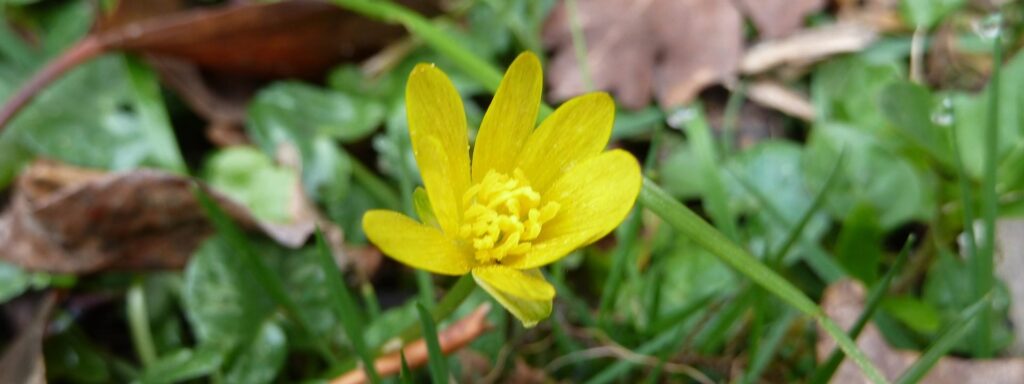
Lesser celandine is related to buttercups and it looks a bit like a buttercup. The difference is that it has more than six narrow yellow petals as opposed to the five broad petals of buttercups.
Narrow-leaved lungwort
This is one of the New Forest’s specialities.
It is very rare in the UK and is only found in the New Forest, a few areas of east Dorset and the northern half of the Isle of Wight. The New Forest National Park holds the majority of the UK’s population of narrow-leaved lungwort.
It is only found in grassy rides or path sides in the ancient deciduous woodlands on fairly fertile, clayey soils. It is important that rides and small glades are kept open for this plant, but the deer do a good job at maintaining the small open areas in woods.
Narrow-leaved lungwort flowers early and the best time to see it is in April, often in the company of other stunning woodland flowers such as wood anemone or bluebell. Many of the old deciduous woods in the Beaulieu area are worth searching for this flower. A good site is along the footpath from Beaulieu to Bucklers Hard: lungwort grows in the first woodland glade you walk through.
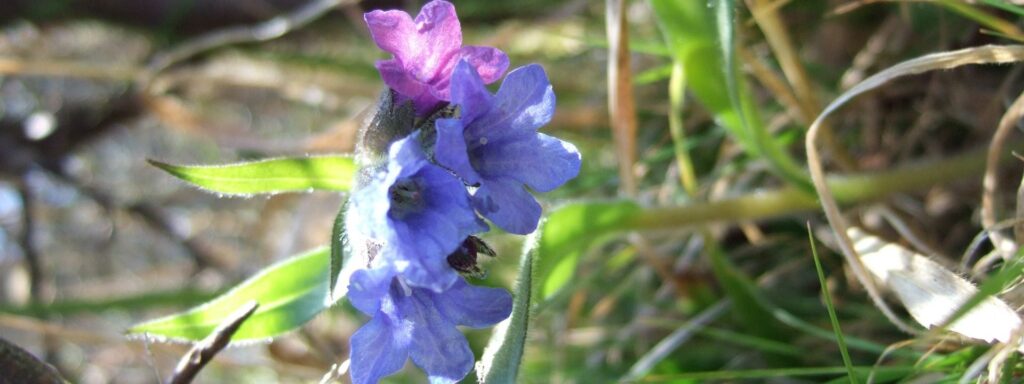
Narrow-leaved lungwort has fairly large green leaves with white spots on and heads of bright blue flowers that are usually pink in bud.
Wild daffodil
Wild daffodil is uncommon and scattered throughout England and Wales.
In Hampshire it is scattered in the New Forest, the countryside surrounding Southampton and the north-east of the county. Populations in the New Forest are scattered, but some are quite large.
It prefers ancient woods that have rich fertile soil and where the soil is damp, eg close to streams or wet flushes. It will also grow in ancient grasslands next to the woods.
Wild daffodil flowers in March and early April. Some of the best populations are in Pinnick Wood, north-east of Ringwood, but it can be tricky to find in wet flushes and boggy parts of the wood. There is much wild daffodil along the lane-sides joining Poulner to the New Forest and this may well be the easiest place to find it.
The beauty of wild daffodils inspired Wordsworth’s famous poem ‘I wandered lonely as a cloud’, and in some parts of the UK special trips were often made to see them in spring.
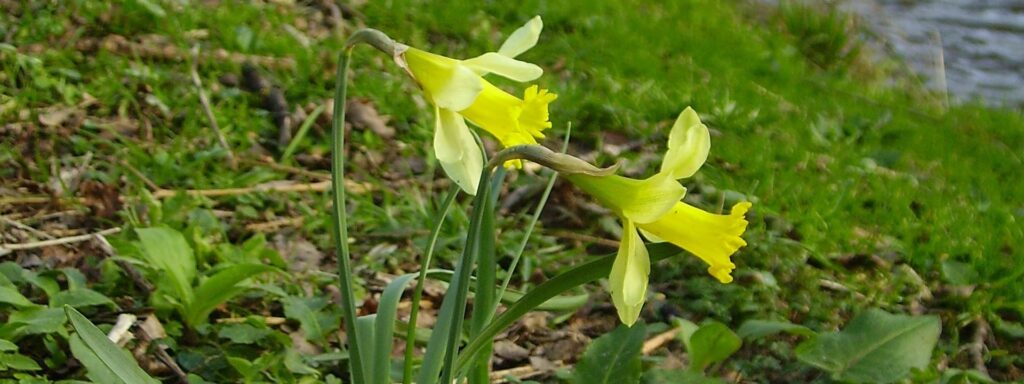
Daffodils are so well known that they do not need any description. The truly wild ones are more delicate than the garden varieties. The petals are a paler yellow than the trumpet and are not held as erect as the garden varieties.
Wood anemone
Wood anemone is a widespread and common species throughout the UK.
In the New Forest there are few woods that have carpets of wood anemone, but they can often be found in small numbers at the edges of ancient oak woodlands. Wood anemones only grow under a shaded canopy. The trees of the woodland provide this, but in the New Forest dense bracken will provide the same habitat and wood anemone can be found quite abundantly in some bracken areas.
One of the best displays of wood anemone is at Ivy Woods, just east of Brockenhurst along the B3 55 towards Beaulieu. You will need to park in the car park and look a little way into the woods — they cannot be seen much from the roadside. A good area to see them in the open before the bracken grows up is at Holmsley. They grow on the slopes on the south side of the disused railway line at the north end of Holmsley Inclosure. Late April is the best time to see them.
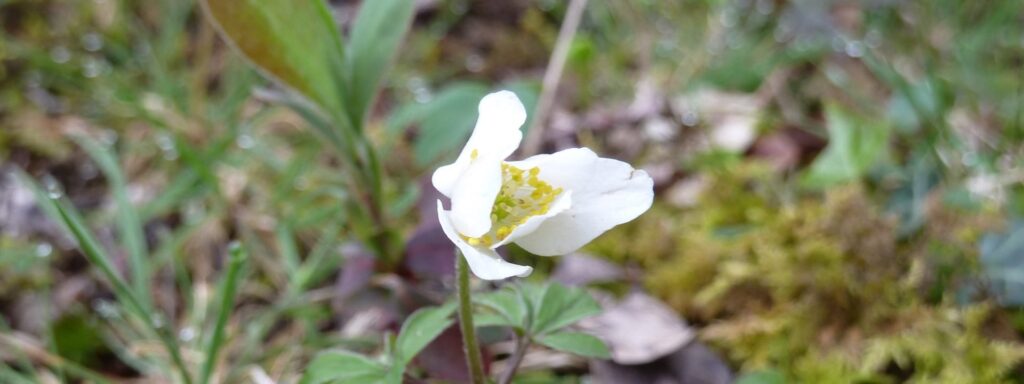
Wood anemone is the only woodland flower that has six (occasionally more) bright white petals in an open star shape. The back of each petal often has a pink or reddish hue.
Wood sorrel
Wood sorrel is common and widespread in woodlands throughout the UK and Hampshire.
It will grow in almost any woodland except the most recently established scrubby woods. In the New Forest it is found in deciduous woods, ride sides in coniferous woods and in parts of the wet valley woodlands.
Wood sorrel is in flower in April in many of the New Forest woodlands, but you will need to look hard to spot the small flowers growing very close to the ground.
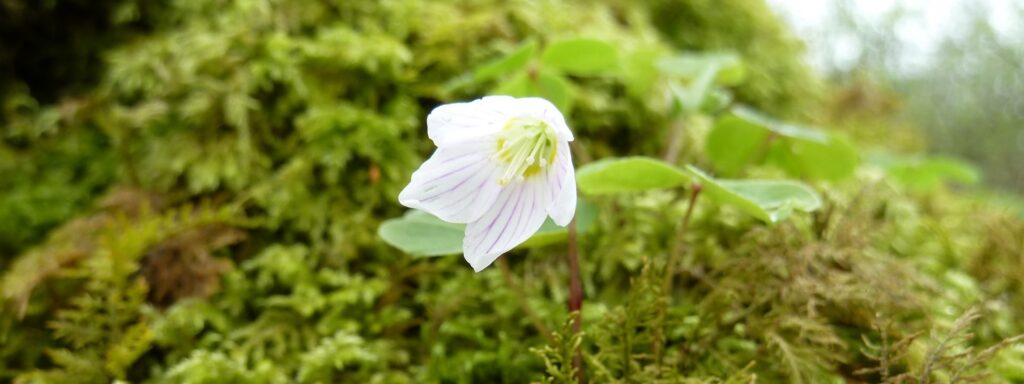
Wood sorrel is a very low-growing plant. It is easily identified by its rosette of three heart-shaped leaves joined together at their tips and the delicately nodding white bell-shaped flowers. The sour, lemon-flavoured leaves are edible, but large quantities can be toxic.
Wood spurge
Wood spurge is very widespread throughout the southern half of England.
In the New Forest it is widespread and found in almost all of the deciduous woodlands. It does not appear to get grazed by deer, cattle or ponies and so, unlike many other woodland flowers, it tends to remain common in the grazed woods of the New Forest.
Wood spurge will grow in any deciduous woods except for the very wet areas. It will often grow in abundance if areas of woodland are cleared. It is easy to find in flower in April or May in many of the New Forest deciduous woodlands.
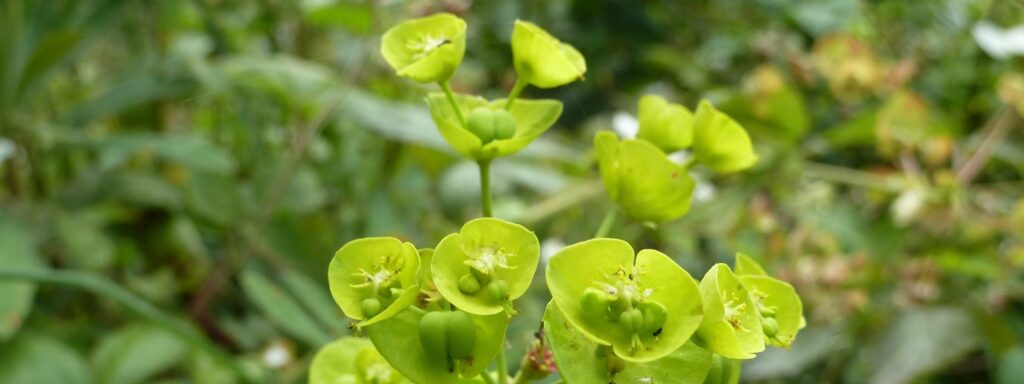
Wood spurge grows about two feet tall and has a clump of bright lime-green flowers at the top. The flowers are not a typical flower shape and look more like green saucers with tiny green cups on. It is the only spurge species in southern England that grows in woods.