17 March 2026
Forest Farming Group
What is the Forest Farming Group?
The Forest Farming Group (FFG) has its origins in the decision of the UK to leave the European Union and consequently the Common Agricultural Policy (CAP).
The CAP has been the mechanism for providing financial support to New Forest farmers and land managers through the Single Payment Scheme, Basic Payment Scheme and environmental stewardship schemes: Countryside Stewardship and Higher Level Stewardship.
The primary focus of the Group has been to work together to:
- promote the need for a bespoke scheme of payments for public ‘goods’ or benefits to be put in place after 2020 (when the UK formally left the EU)
- obtain appropriate reward for the New Forest’s farmers for the environmental services that they provide, either through practising their common rights or managing their land within and around the National Park.
The group has identified the range of public goods provided by the New Forest and published the report ‘Understanding the New Forest’s Natural Capital’ in 2018 which gives an evidence base and proposes a structure to help create a replacement for the current system that will be specially suited to the New Forest area.
The Group has made representations to government ministers and officials and responded to consultations on the future of farming and the Environmental Land Management (ELM) Policy Discussion Document.
The primary purpose of the Group is to work collaboratively to ensure continued financial support from the emerging ELM Scheme after it runs out in 2028 and other sources of funding in order to maintain and enhance the public goods that the New Forest provides to society.
In so doing the Group will provide a single voice to represent members on key issues while ensuring it complements and supports, rather than duplicates, the work of other groups and agencies.
It is not intended for the membership of this Group to automatically become signatories and/or beneficiaries of a new scheme.
What are the Group's aims?
To deliver the public goods defined in the Government’s 25-year Environment Plan and those identified in the FFG’s Natural Capital Report the FFG seeks to ensure that any Environmental Land Management Schemes (ELM) are fit for purpose for the unique landscape of the New Forest and its people. In doing so ELM will deliver landscape and nature recovery while protecting the traditional way of commoning and Forest life.
The FFG works collaboratively in designing a ‘joined up’, landscape-scale land management scheme over the New Forest National Park’s 27,691 hectares (68,424 acres) of common land (Ref C). As such it is critical that future land management schemes operating in the New Forest fulfill the following objectives:
- Bespoke and flexible in nature
- Delivers nature recovery through habitat restoration and management which protects and enhances biodiversity and sequesters and stores carbon
- Delivers enhancements in water quality across the catchment
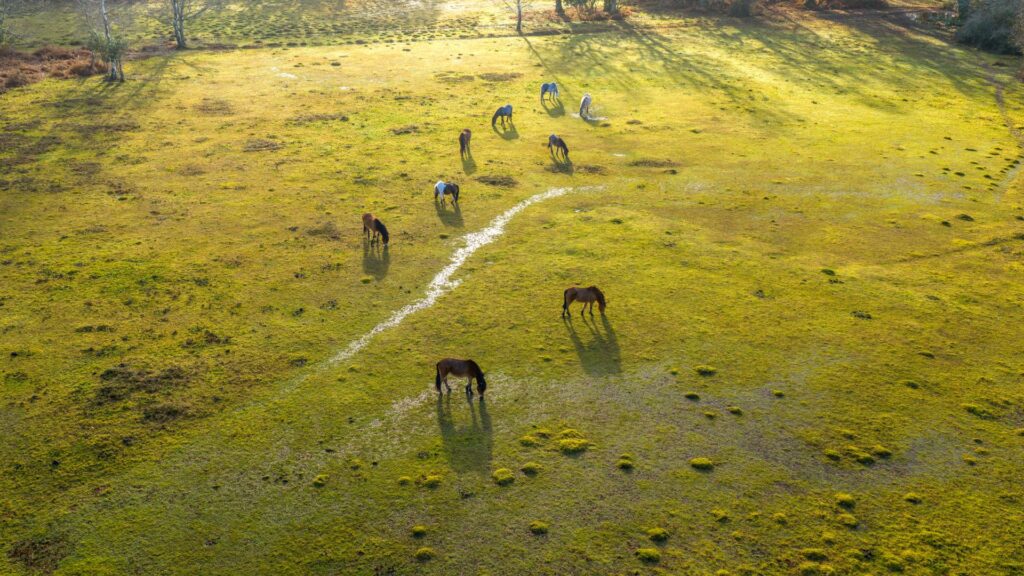
- Protects and promotes a sustainable and robust commoning system with the highest standards of animal welfare
- Supports enhanced management of recreation
- Facilitates educational engagement
- Protects and enhances the New Forest’s historic environment and landscape character
- Improves air quality in the area.
What's next for the Higher Level Stewardship (HLS) scheme?
Through the Group, the Forest was awarded a grant for a feasibility study to investigate the eligibility requirements and appropriateness of the various options for future funding applications after the HLS scheme funding ends in 2028.
As part of this work a consultation with common rights holders was carried out. The outcomes of this consultation are detailed in this Commoners Consultation report.
This ‘PA2’ feasibility study was produced by a local consultant in 2025 at the request of Defra.
Forest representatives met with Defra officials when they visited in May 2025 to discuss the study and the future funding of the Forest .
The general feeling was that a Landscape Recovery scheme is the best type of scheme for the Forest to move into. An expression of interest is being prepared.
If the expression of interest is successful, funding would be given for a two-year development phase to work up the details of the scheme for the Forest and set it up. Covering 94,000 hectares, it would be the biggest Landscape Recovery scheme in England.